



Last Updated: September 21st, 2026
Reading Time: 9 mins
Thyroid problems in women go unnoticed for years mainly because the symptoms overlap so closely with menopause, stress, and ordinary ageing that neither patients nor a quick GP check always thinks to test for it. Add in a condition that can affect two directions at once, either speeding the body up or slowing it right down, and it’s easy to see why so many cases sit undiagnosed for a long time.
This isn’t a rare oversight. Thyroid disease is common, genuinely under-recognised, and disproportionately affects women. This guide explains why it’s missed so often, what the two main patterns look like, and how it’s actually diagnosed and treated.
Thyroid problems and symptoms in women are frequently missed because almost every symptom the thyroid produces has a more “obvious” everyday explanation attached to it first. Fatigue gets blamed on a busy life. Weight change gets blamed on diet or age. Mood changes get blamed on stress. Each explanation is plausible on its own, which is exactly the problem, nobody sees the whole pattern until it’s pointed out.
Women are affected far more than men, roughly five to eight times more often, and around one in twenty UK adults has some form of thyroid disease at any given time. Because the standard first-line blood test, TSH, doesn’t always capture the full picture on its own, an underactive or overactive thyroid can sit just outside what gets flagged as abnormal, especially early on, while the symptoms it’s already causing are written off as something else entirely.
Signs of thyroid problems women notice most often fall into a fairly consistent cluster, even though the underlying direction of change, underactive versus overactive, can differ from person to person. It’s this cluster, rather than just one symptom in isolation, that’s actually worth paying attention to:

High thyroid problems in women, meaning an overactive thyroid rather than an underactive one, tend to produce a different symptom set: a racing heart, restlessness, trouble sleeping, tremor, and sudden weight loss despite eating normally. This pattern is particularly easy to misdiagnose as anxiety, since the physical sensations, a pounding heart, a sense of unease, difficulty settling, overlap heavily with how anxiety itself presents. Getting this distinction right matters, because the two need entirely different management.
Thyroid problems in women weight gain and thyroid problems in women weight loss point in opposite directions for a reason, they usually reflect the two different underlying patterns. An underactive thyroid slows your metabolism, which commonly shows up as gradual weight gain alongside the fatigue and low mood already mentioned. An overactive thyroid does the reverse, speeding the metabolism up enough that weight can drop even when appetite and food intake haven’t changed. Neither pattern is subtle once you know to look for it, but without that context, both get quietly absorbed into “that’s just what happens as you get older.”
Seeing the two patterns side by side often makes the distinction click faster than reading about them separately:
| Underactive Thyroid | Overactive Thyroid | |
| Weight | Gradual weight gain | Weight loss despite normal appetite |
| Heart rate | Slower than usual | Faster, sometimes irregular |
| Energy | Persistent fatigue, sluggishness | Restlessness, difficulty settling |
| Temperature | Feeling unusually cold | Feeling unusually warm, sweating |
| Mood | Low mood, flat affect | Anxiety, irritability |
| Bowel habit | Constipation | Looser, more frequent stools |
| Sleep | Excessive tiredness, wanting more sleep | Trouble falling or staying asleep |
Can thyroid problems cause hair loss in women? Yes, both an underactive and an overactive thyroid can cause diffuse hair thinning, usually across the whole scalp rather than in a specific pattern. This tends to develop gradually, often noticed as more hair than usual coming out during washing or brushing, and it’s one of the more common reasons thyroid disease first gets picked up, particularly when the thinning doesn’t respond to the usual approaches. It’s worth being clear, though, that thyroid disease is only one of several possible causes of hair thinning at this life stage, and it’s usually accompanied by at least one or two of the other signs above rather than appearing entirely on its own. Genetic pattern thinning and stress-related shedding are both more common causes overall, our earlier guide on hair loss in menopause covers those in more depth if hair change is your main concern rather than the wider thyroid picture.
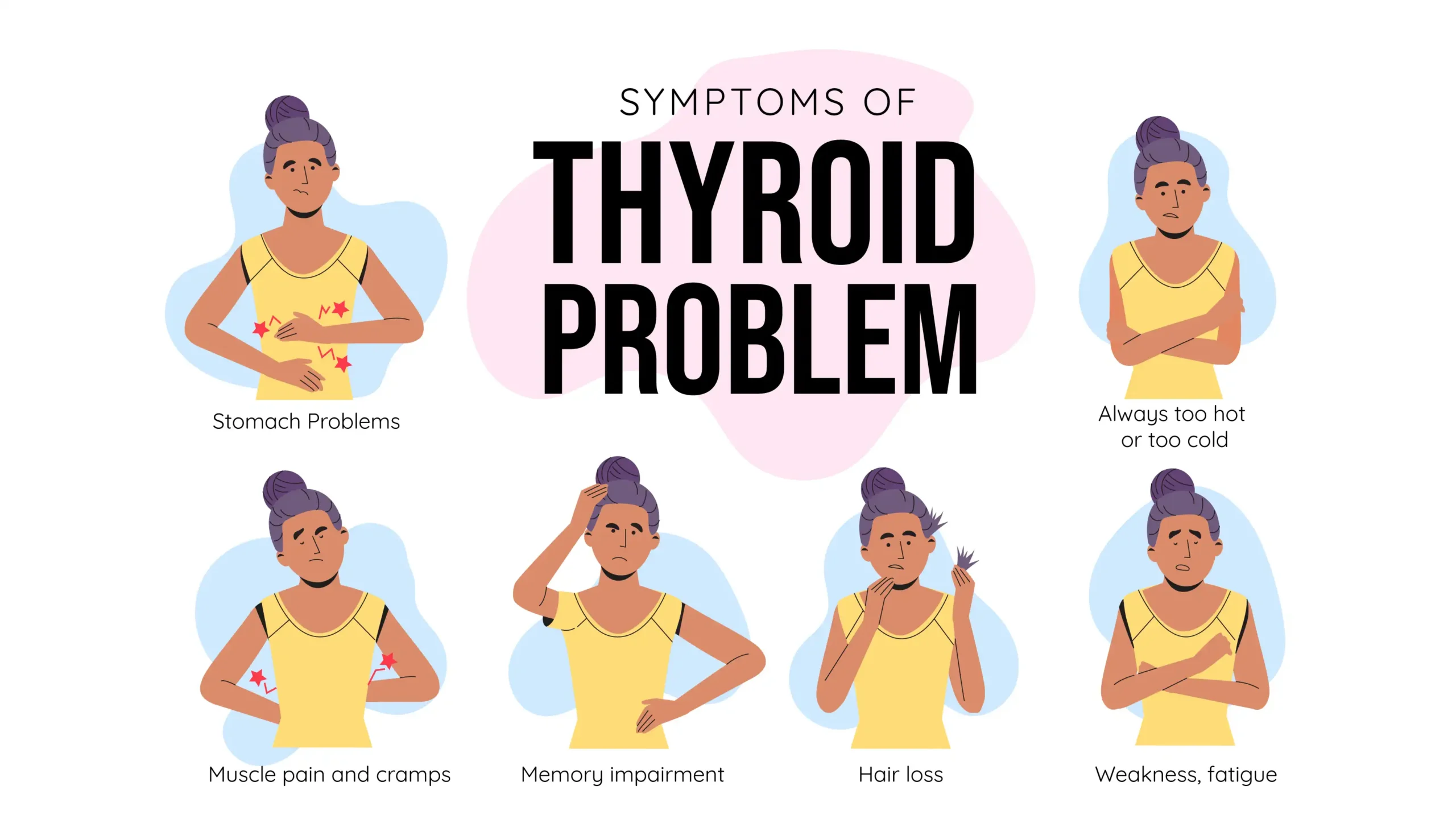
Thyroid and women’s hormones are more closely linked than most people realise. Thyroid hormone interacts directly with the reproductive hormone system, and an under- or overactive thyroid can disrupt the menstrual cycle, sometimes making periods heavier, lighter, or less regular than usual. This connection runs in both directions too, the hormonal shifts of perimenopause and menopause can make existing thyroid symptoms harder to distinguish from the menopause transition itself, which is part of why thyroid disease is so often missed at exactly this stage of life.
Confirming a thyroid problem properly generally starts with a TSH blood test, but TSH alone doesn’t always tell the full story, since it can occasionally sit within a broad “normal” range even when the thyroid is genuinely underactive or overactive, especially in early or borderline disease. This is exactly what can thyroid issues cause to be missed for so long, an incomplete picture from a single test taken in isolation.
A more complete assessment typically includes:
None of this needs to feel complicated. A proper assessment that looks at TSH and FT4 together, rather than TSH in isolation, is usually enough to catch what a single test might miss, and it’s exactly the kind of thing worth asking for directly if your symptoms don’t match what a “normal” TSH result seems to suggest.
To make this concrete: a TSH result at the upper edge of the normal range, alongside an FT4 that’s sitting at the lower edge of its own normal range, can still mean an underactive thyroid is developing, even though neither number alone would be flagged as abnormal on a standard report. Seen together, though, that pairing tells a clearer story, and it’s exactly the kind of pattern a single TSH-only test can miss entirely. This is why looking at both results side by side, rather than one in isolation, matters so much in practice.
Thyroid disease in women treatment depends entirely on which direction the thyroid has shifted. An underactive thyroid is generally managed with thyroid hormone replacement medication, taken daily, with blood tests repeated periodically to fine-tune the dose until levels settle into a stable range. An overactive thyroid has a different set of options depending on the underlying cause, sometimes medication to reduce hormone production, and occasionally other treatments where medication alone isn’t enough. Getting the dose right, in either direction, usually takes a few rounds of testing and adjustment rather than a single fix, and ongoing monitoring is a normal, expected part of the process rather than a sign something has gone wrong.
Thyroid problems in pregnant women need their own careful approach, since thyroid hormone plays a direct role in a baby’s early development and the targets used for treatment are tighter than they are outside pregnancy. Current UK guidance aims for a TSH below roughly 2.5 mIU/L both before conception and throughout pregnancy for women already on thyroid hormone replacement. Left inadequately treated, hypothyroidism in pregnancy carries real risks, including miscarriage, effects on the baby’s neurological development, preterm delivery, and other pregnancy complications. The reassuring part is that adequately treated thyroid disease in pregnancy is not associated with these increased risks, which is exactly why early testing and close monitoring matter so much here, this is a conversation for us to have well before or as early as possible during pregnancy, rather than waiting until a routine scan.
Can women with thyroid problems get pregnant? Yes, the great majority of women with a well-managed thyroid condition conceive and carry a pregnancy without added difficulty. Untreated or poorly controlled thyroid disease can affect fertility and increase pregnancy risk, which is why getting your levels properly assessed and stabilised before trying to conceive, where that’s possible, makes a genuine difference. If you’re planning a pregnancy and know or suspect you have a thyroid condition, that’s worth discussing with us in advance so your levels and treatment can be reviewed together.

Dr Raquel Delgado is a private GP in London with more than 20 years of clinical experience in general practice, women’s health, and hormonal care. She has a particular focus on doctor-led, natural-looking aesthetic treatments for women, and consults in both English and Spanish. Every consultation is with Dr Delgado personally, giving you the same clinician’s judgement and continuity of care each time.
If your symptoms don’t quite add up, or a previous thyroid test came back “normal” but nothing’s actually settled, that’s worth a proper assessment rather than continuing to put it down to stress or age. In Dr Raquel Delgado‘s experience, a full picture, TSH and FT4 together, alongside your actual symptoms and history, catches far more than a single test viewed alone.
You can read more about our approach on our Women’s Health page, our GP services more broadly if this is one of several things you’d like assessed together, or on our homepage for a wider view of the practice. Our Wellness Library and Resources sections also have further reading if you’d like to explore the broader hormonal picture in your own time. To arrange a consultation, contact us directly or reach out using the details below:
If you’re experiencing a rapid heart rate, significant unexplained weight change, or feel unwell alongside these symptoms, that needs prompt attention rather than waiting for a routine appointment.
The earliest signs are often non-specific, fatigue, mood changes, and subtle weight change, which is exactly why they’re so easy to dismiss. A cluster of several signs together, rather than one in isolation, is a more reliable prompt to get tested than any single symptom alone.
Not always. TSH is the standard first test, but it can occasionally sit within a normal range even when other markers, or your actual symptoms, suggest otherwise. If your symptoms persist despite a “normal” TSH, asking for FT4 to be checked alongside it is a reasonable next step.
Autoimmune thyroid conditions, which are among the most common causes of both an underactive and overactive thyroid, do run in families to some degree. Having a close relative with thyroid disease doesn’t mean you’ll develop it, but it’s a useful piece of history to mention when being assessed.
Yes, it commonly does, often making periods heavier or less regular than usual. Because this overlaps so closely with normal perimenopausal cycle changes, thyroid testing is a sensible step to include whenever cycle changes are being assessed around this life stage.
This article is for general information and does not replace a personal consultation. If you have concerns about thyroid symptoms, please get in touch with us promptly.
Webdesign by EyeMedia Creative