



Last Updated: October 26th, 2026
Reading Time: 10 mins
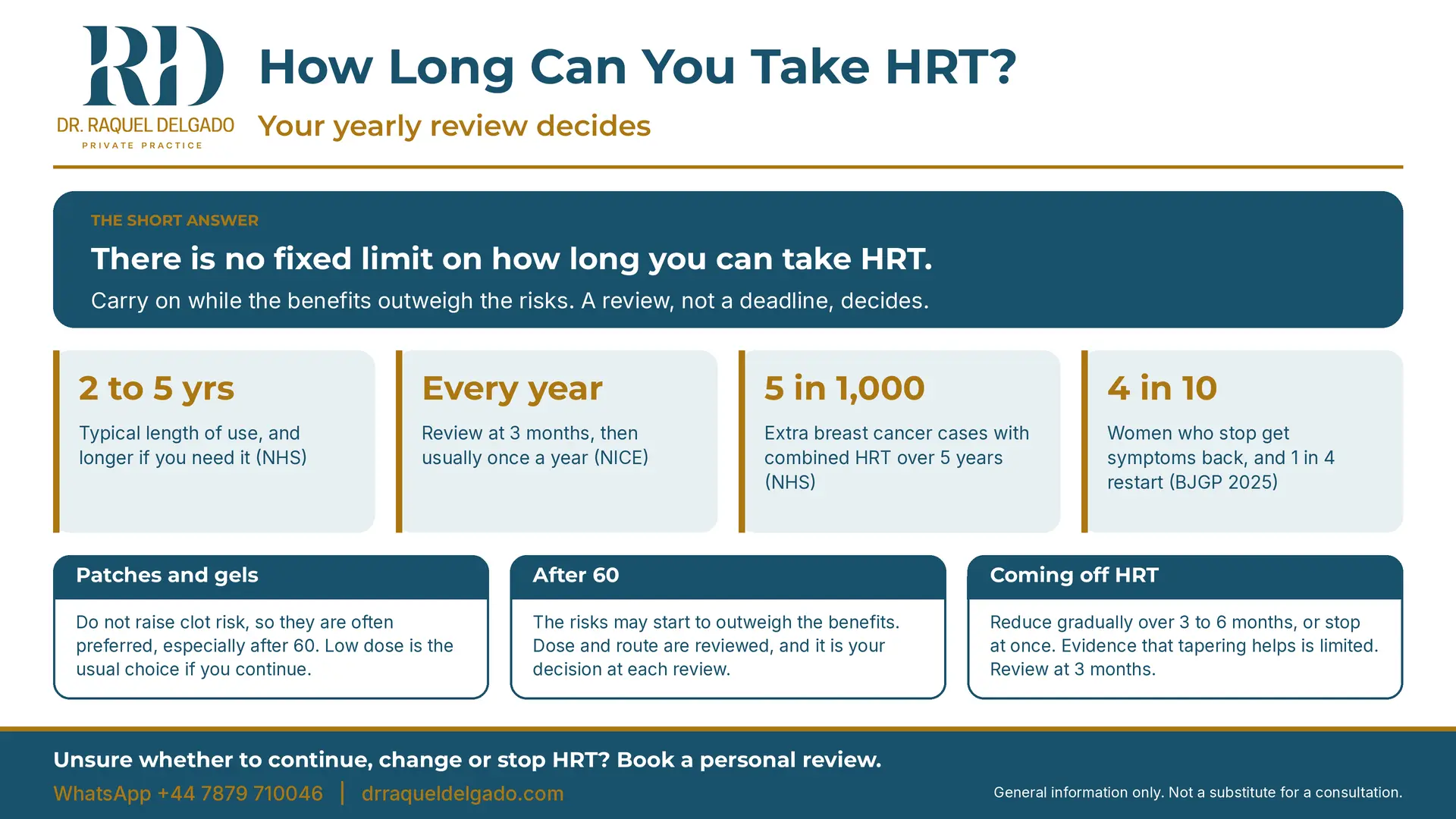
How long can you take HRT? There is no fixed limit. The NHS, NICE and the British Menopause Society agree that you can carry on for as long as the benefits outweigh the risks, and a review, usually once a year, decides. Most women use HRT for around 2 to 5 years, and some need longer. This guide covers what the guidance says, how the balance changes with age and type of HRT, what HRT protects against and how to come off it when the time is right.
Key points
The NHS says there is no fixed limit and that treatment is usually reviewed every year. The NICE menopause guideline (NG23, updated November 2024) advises a review at 3 months and then annually, sooner if there are side effects or the treatment isn’t working. The British Menopause Society says arbitrary limits shouldn’t be placed on the dose or duration of HRT. So the answer to whether there is a time limit on HRT is no, but there is a check-in.
Why a review and not a deadline? Because the balance shifts as you get older. Symptoms often ease over time, while some risks, such as breast cancer with combined HRT, grow the longer you take it. A yearly review lets us ask the same two questions each time: do you still need it, and are the risks still acceptable for you? Bleeding that is unexpected after the first few months also needs checking, and our guide to bleeding on HRT explains what we look for.
How long can you be on HRT in practice? The NHS says most women need it for 2 to 5 years, although it can be longer. That is a typical range, not a limit. Hot flushes and night sweats often settle within a few years, which is when many women choose to come off. Others find symptoms return whenever they try, and decide to carry on after weighing the benefits and risks with us. Neither choice is wrong. What matters is that the decision is made deliberately at a review, not by a number on a calendar.
Before thinking about stopping, it helps to know how long HRT takes to start. How long will HRT take to work? The NHS says symptoms usually improve after a few days or weeks. NICE advises a review at 3 months, so that is the point to tell us if you haven’t noticed enough improvement, as the dose or type may need to change. Our guide to hot sweats explains why night sweats wreck sleep and what else can help while HRT settles in.
How long is it safe to take HRT depends on which HRT you take, your age and your own health. Oestrogen-only HRT, which is for women without a womb, is associated with little or no change in breast cancer risk. Combined HRT can increase it, and the increase relates to how long you take it. For many women under 60 with symptoms, the benefits are judged to outweigh the risks. Is long-term HRT safe? For many women it can be, but safety isn’t a single number of years. It is your personal balance, checked every year.
How long can you be on hormone replacement therapy after 60? The NHS says that as you get older, and especially after 60, the risks may start to outweigh the benefits, because symptoms usually improve with age while the breast cancer risk with combined HRT rises with duration. If you want to continue, or to start after 60, it suggests a low dose using patches or gel rather than tablets. The British Menopause Society advises the lowest effective dose and no arbitrary limits. These fit together. Neither source sets an age at which HRT must stop, but the case for continuing needs re-examining, and the dose and route are often adjusted. So can you take HRT after 60? Yes, for some women, after a careful review. Staying on into your sixties after that review is a defensible choice, and so is stopping.
Benefits outweigh risks is the phrase behind almost every HRT decision, and the answer differs by type. This table summarises the main differences, based on NHS and NICE information:
| Type of HRT | Breast cancer risk | Blood clot risk |
| Oestrogen-only tablets | Little or no change | Small increase |
| Oestrogen-only patch, gel or spray | Little or no change | No increase |
| Combined HRT tablets | Can increase, linked to duration | Small increase |
| Combined HRT patch or gel | Can increase, linked to duration | No increase |
| Vaginal oestrogen | No increase | No increase |
The NHS puts the combined HRT breast cancer figure at around 5 extra cases per 1,000 women who take it for 5 years. The risk rises the longer you take it and the older you are, and it falls again after you stop. That is the core of breast cancer risk and HRT duration, and it is why not taking combined HRT for longer than you need it is one way to lower the risk. In absolute terms these increases are small.
What does benefits outweigh the risks mean? It means that, for you, the good HRT does is bigger than the harm it could do, given your age, health and the type you take. The good includes relief from hot flushes, night sweats, poor sleep and low mood caused by menopause, and protection for your bones. It isn’t a promise of no risk. It is a judgement, and it can change. A woman of 52 with severe hot flushes and no risk factors has a different balance from a woman of 66 whose symptoms have settled. That is why we review and don’t set a deadline.
What does HRT protect against? This is what the evidence supports:
Some things people expect are less clear. NICE says HRT started before 60 doesn’t increase cardiovascular risk, and the NHS says it has little or no effect on coronary heart disease. HRT isn’t prescribed to prevent heart disease. Whether it affects dementia risk is unknown, and it isn’t prescribed for that either.
Does HRT protect against osteoporosis? Yes. NICE says fracture risk is decreased while you take HRT, and that the benefit decreases once treatment stops. The British Menopause Society describes the bone effect as dose and duration related, with some studies suggesting protection can last for years after stopping. HRT and bone protection matter most with premature ovarian insufficiency and for symptomatic women under 60, where the Society describes HRT as first-line for preventing osteoporosis. Weight-bearing exercise, enough calcium and vitamin D and not smoking also help, and we can discuss whether a bone density scan suits you.
Low dose HRT benefits are often discussed for women continuing into their sixties. The NHS suggests a low dose with patches or gel if you keep taking HRT after 60, and the British Menopause Society advises the lowest effective dose. Low-dose HRT can control symptoms for some women and may mean fewer side effects. The evidence that a low dose gives the same symptom control or bone protection as a standard dose is limited, though. If a lower dose leaves symptoms uncontrolled, adjusting it is a fair option. The aim is the lowest dose that works for you, found through trial and review.
How long can you stay on HRT patches? The patch sets no time limit. The route changes the risk profile, not the maximum duration. NICE says transdermal HRT at standard doses carries no greater clot risk than your baseline, while oral HRT increases it. That is why patches are often preferred if you have a higher clot risk, or after 60. Breast cancer considerations for combined HRT still apply to patches.
How long do you keep HRT patches on for each time? The NHS says you usually change a patch every few days, but each brand is different, so follow your instructions. If a patch keeps coming off or irritates your skin, tell us and we can look at another option.
Two groups follow different rules. If your periods stopped before 40, which is called premature ovarian insufficiency, NICE advises continuing hormone treatment until at least the age of natural menopause, and the NHS says usually until at least 51. The aim is protecting your bones and long-term health as well as easing symptoms.
Vaginal oestrogen is different again. It is a low dose placed inside the vagina for dryness, burning or pain during sex. The NHS says it doesn’t raise breast cancer or clot risk and can be used for as long as you need it, and NICE adds that symptoms often come back when you stop. Vaginal oestrogen long term is reasonable for many women. It doesn’t help hot flushes, so some women use it alongside other HRT.
How to come off HRT depends on your preference and how you feel. NICE says women stopping should be offered a choice of gradually reducing the dose or stopping immediately, and the NHS says reducing over 3 to 6 months is usually recommended. A sensible path looks like this:
The conversation about stopping in Dr Raquel Delgado‘s consultations starts with why. Some women want to stop because of a side effect, and a change of type or route is often a better answer than stopping. If the progestogen part is what makes you feel unwell, our guide to progesterone intolerance explains the alternatives. Others want to stop because of a number, such as 5 years or age 60, and we would rather you stop because you are ready than because of a date. If you are weighing this up, our Women’s Health service can help.
Tapering off HRT is commonly advised, and NICE says gradual reduction may limit the return of symptoms in the short term. The evidence is thinner than most people expect, though. NICE found four small randomised trials of low to very low quality with inconsistent results, and a 2025 British Journal of General Practice editorial says whether tapering works better is still unknown. NICE also says that over the longer term, gradual and immediate stopping make no difference to symptoms.
So tapering is a reasonable choice if it helps you feel in control, but it isn’t a guarantee. The same editorial reports that more than 4 in 10 women who stop get symptoms back, and more than 1 in 4 restart. If that happens, you haven’t done anything wrong.

Dr Raquel Delgado is a private GP in London with more than 20 years of clinical experience in general practice, women’s health, and hormonal care. Focus areas include doctor-led, natural-looking aesthetic treatments for women, with consultations in both English and Spanish. Every consultation is with Dr Delgado personally, giving you the same clinician’s judgement and continuity of care each time.
If you are unsure whether to continue, change or stop HRT, that calls for a proper review, not a guess. We can look at your symptoms, your age, the type of HRT you take and your own risk factors, and talk through the options at your pace. You can read more about our GP services, visit our homepage, or browse our Wellness Library for further reading. To arrange a consultation, contact us directly or reach out using the details below:
A few signs call for prompt attention rather than waiting:
If any of these apply to you, that needs proper assessment with us rather than being left to settle on its own.
No. The NHS sets no fixed limit, and the British Menopause Society advises against arbitrary limits on duration. The NHS says the risks may start to outweigh the benefits after 60, so the dose and route are reviewed, often moving to a low dose patch or gel.
There is no fixed limit, so you can carry on for as long as the benefits outweigh the risks. That is decided at your yearly review.
They can. A 2025 editorial reports that more than 4 in 10 women who stop get symptoms back, and more than 1 in 4 restart. If symptoms return and don’t settle within 3 months, speak with us.
NICE advises a review at 3 months and then once a year, sooner if you have side effects or HRT isn’t working.
Yes. NICE and the NHS both say the increased risk linked to combined HRT reduces after you stop.
Not automatically. Five years is a typical length of use, not a rule. We look at your symptoms, age and risks and decide with you.
This article is for general information and does not replace a personal consultation. If you have concerns about HRT, unusual bleeding or any change in your breast, please get in touch with us promptly.
Webdesign by EyeMedia Creative