



Last Updated: September 12th, 2026
Reading Time: 9 mins
Yes, anovulatory cycles could well be why your period feels off, later, lighter, heavier, or just different from what you’re used to. An anovulatory cycle happens when your ovary doesn’t release an egg that month, and although it can still involve bleeding, that bleeding works differently to a typical period underneath the surface.
This is far more common than most women realise, and on its own it isn’t automatically a sign that something is wrong. It becomes especially common heading into perimenopause, but it can happen at other life stages too, for a range of different reasons. This guide explains what’s actually happening in your body during an anovulatory cycle, why it shows up more often as you get older, how it’s actually diagnosed, and when it’s worth having properly checked rather than just watched.
What is anovulatory cycle mean in practice? It means your ovary hasn’t released an egg during that particular cycle, even though you may still bleed on a roughly monthly basis. In a typical, ovulatory cycle, releasing an egg triggers the second half of your cycle, when progesterone rises steadily and then falls, and that fall in progesterone is what actually triggers your period to start. Without ovulation, progesterone never rises in the same organised way, so that whole sequence doesn’t play out as expected.
Instead, the bleeding that follows an anovulatory cycle is sometimes called oestrogen breakthrough bleeding. Your oestrogen keeps building up the lining of your womb without progesterone there to balance and eventually stabilise it. Over time, that lining becomes thicker and less stable than it should be, and it eventually breaks down and sheds on its own terms rather than on a predictable schedule. The bleeding this produces can look similar to a normal period at a glance, but it isn’t driven by the same hormonal sequence underneath, which is exactly why anovulatory cycle bleeding can behave so unpredictably, arriving early, late, lighter, or considerably heavier than your usual pattern.
It’s worth saying clearly that having the occasional anovulatory cycle doesn’t mean your reproductive system is failing or that anything is fundamentally wrong. It’s a normal variation that happens to almost everyone at some point, the real question is usually how often it’s happening and what’s driving it in your specific case.
Symptoms of anovulatory cycle vary quite a bit from person to person, partly because the underlying hormone pattern behind each one varies too. Some women notice very little difference at all from their usual cycle, while others notice a cluster of changes that, taken together, point toward a cycle without ovulation.
Common signs include:
None of these signs on their own confirm an anovulatory cycle with certainty, and the only truly reliable way to know is through hormone testing at the right point in your cycle or careful tracking over several months. Still, noticing this pattern together over two or three cycles is a reasonable, sensible prompt to get things looked at properly rather than dismissed.
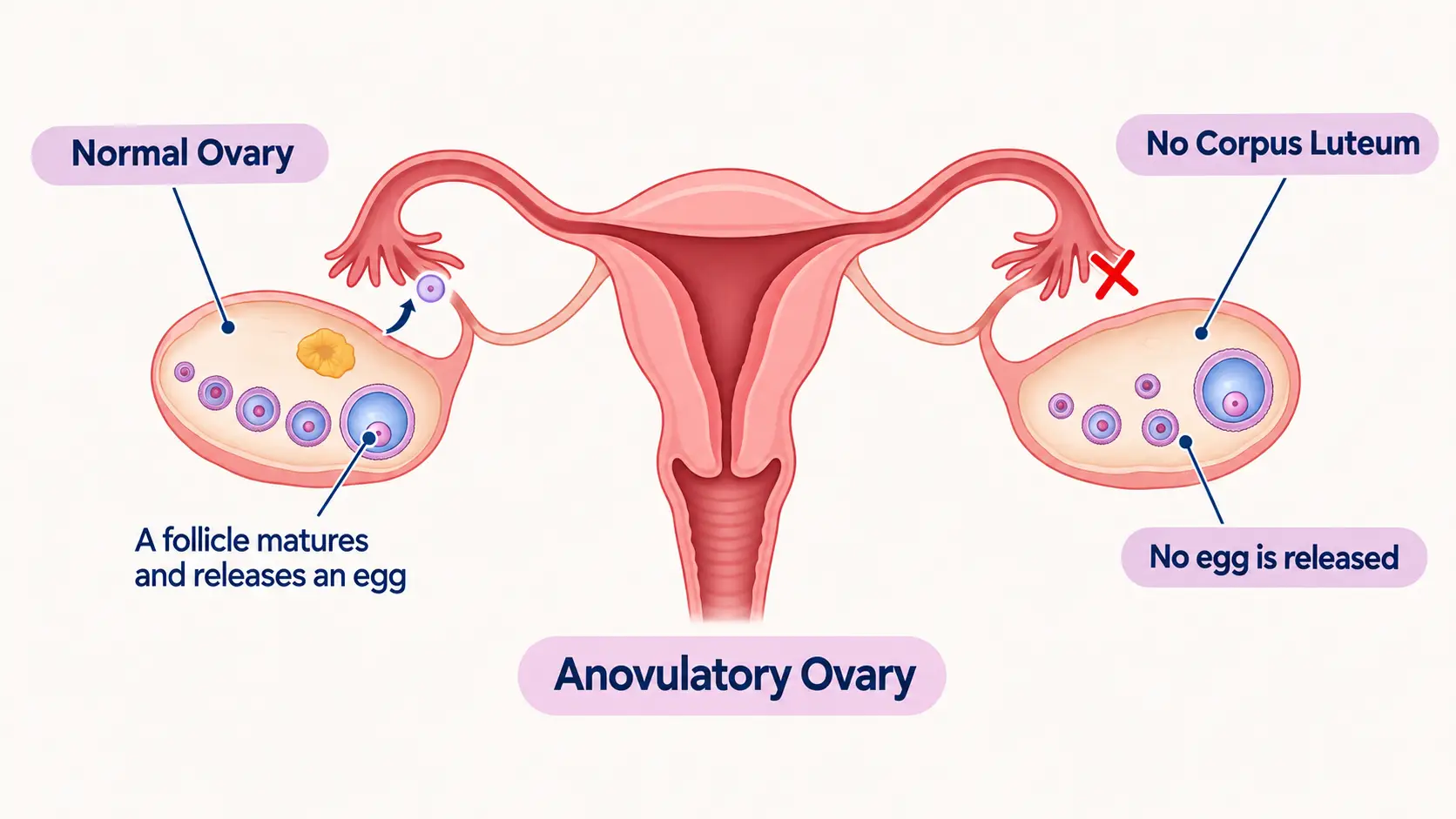
Anovulatory cycle perimenopause is one of the most common pairings in women’s health, and for good clinical reason. What causes anovulatory cycles at this particular stage of life comes down largely to a natural decline in the number and quality of the egg follicles remaining in your ovaries. As that pool of follicles shrinks and becomes less responsive, your ovaries react less predictably to the hormonal signals that would normally trigger ovulation each month, and some cycles simply skip the process altogether.
There are other reasons for anovulatory cycles too, and they’re worth knowing about, since perimenopause is far from the only cause. Polycystic ovary syndrome is one of the most common, it involves multiple small, immature follicles that never quite mature enough to release an egg, usually alongside higher-than-average LH and testosterone levels. Thyroid dysfunction, elevated prolactin, significant psychological stress, very low body weight, or extreme levels of exercise can all disrupt the finely balanced hormonal signalling that ovulation depends on too, at essentially any age or life stage. Anovulatory cycle hormone levels typically show lower progesterone throughout what should be the second half of the cycle, since progesterone is only really produced once ovulation has actually taken place, alongside oestrogen patterns that can swing noticeably higher or lower than usual depending on the underlying cause.
In Dr Raquel Delgado‘s clinical experience, many women are surprised to learn how many different factors, not just perimenopause, can disrupt ovulation at different points in life, and that the same symptom pattern can have several quite different underlying explanations depending on someone’s age and wider health picture.
Can anovulatory cycles be regular, in the sense of arriving roughly on schedule each month? Yes, and this often surprises a lot of women when they first hear it. NICE, the UK body that sets national clinical guidance, recommends a blood test measuring progesterone around day 21 of a 28-day cycle specifically because a regular monthly cycle on its own doesn’t confirm ovulation has actually happened. Population studies back this up: somewhere between 10 and 18% of cycles that look completely regular from the outside are actually anovulatory, which means a meaningful number of women go through them without ever realising anything is different.
Are anovulatory cycles common more broadly? Very. An occasional anovulatory cycle is considered a normal, expected part of puberty, perimenopause, and periods of significant physical or emotional stress. In the final year before menopause specifically, research suggests roughly 6 in every 10 cycles are anovulatory, which makes it very much the rule rather than the exception at that particular stage, and not something to be alarmed by purely on its own.
Since none of the symptoms above confirm an anovulatory cycle on their own, diagnosis usually comes down to a short, focused set of tests rather than guesswork. As mentioned above, NICE recommends a progesterone blood test around day 21 of a 28-day cycle, adjusted for your own cycle length, as the main way to confirm whether ovulation actually happened that month. A result above roughly 30 nmol/L generally points to ovulation having occurred, while a lower result may need repeating with closer attention to timing.
Alongside that, a few other tests help build the full picture:
What happens next depends entirely on what these results show. For some women, straightforward lifestyle changes, addressing significant stress, restoring a healthy weight, or adjusting an intense exercise routine, are enough to bring ovulation back on its own. Others need a specific underlying cause treated directly, such as thyroid hormone correction, and some benefit from hormonal support tailored to their individual results rather than a generic starting point. If you’ve been trying to conceive and anovulatory cycles keep coming up, referral for a more detailed fertility assessment is usually the next sensible step.
Why do anovulatory cycles cause heavy bleeding more often than a typical, ovulatory period does? The answer comes back to that same underlying hormone imbalance described earlier. Without ovulation, progesterone never rises to stabilise the uterine lining properly, so oestrogen continues building that lining up unopposed, sometimes for considerably longer than a normal cycle would allow. When that thickened lining eventually does break down, it can shed more heavily, more unpredictably, and over a longer stretch of days than a typical period would. This is also exactly why anovulatory cycle when will period come becomes such a common, understandable question, without an ovulation event marking a fixed countdown, the timing becomes much harder to predict from one cycle to the next.
A few patterns tend to show up often alongside this kind of bleeding:
If heavy or prolonged bleeding is affecting your daily life, your energy levels, or you’re needing to change protection unusually often, that’s worth having assessed properly with us rather than simply managing around it indefinitely. Our earlier guides on heavy periods in perimenopause and bleeding between periods cover the symptom side of this in more depth, if that’s your main concern rather than the underlying mechanism itself.

Dr Raquel Delgado is a private GP in London with more than 20 years of clinical experience in general practice, women’s health, and hormonal care. She has a particular focus on doctor-led, natural-looking aesthetic treatments for women, and consults in both English and Spanish. Every consultation is with Dr Delgado personally, giving you the same clinician’s judgement and continuity of care each time.
If your cycles have become unpredictable, or you’re specifically concerned about anovulatory cycles, that’s worth a proper assessment rather than waiting to see what happens over the next few months. We look at your cycle history, your hormone levels, and any other symptoms together, so we can tell you what’s actually happening in your case rather than leaving you to guess at it alone.
You can read more about our approach on our Women’s Health page, or our GP services more broadly if this is one of several things you’d like assessed together in one visit. To arrange a consultation, contact us directly or reach out using the details below:
If you’re experiencing very heavy bleeding, bleeding that won’t settle, or significant pain alongside these cycle changes, that needs prompt attention rather than a routine, wait-and-see appointment.
Anovulatory cycle when will period come is one of the hardest parts to predict, precisely because there’s no ovulation event marking a fixed countdown to your next bleed. Some anovulatory cycles run considerably shorter than usual, others run much longer, and the timing can vary quite a bit even for the same person from one cycle to the next, which is part of what makes it feel so unsettling.
Neither answer is reliably true on its own, which often surprises people. Are anovulatory cycles painful, or are anovulatory cycles painless, genuinely depends on the individual, since ovulation-type pain can still occur even in cycles where ovulation hasn’t actually happened, and plenty of women ovulate without ever feeling anything at all. In short, pain, or the absence of it, isn’t a dependable way to tell whether a particular cycle involved ovulation.
No, not from that specific cycle. Anovulatory cycle pregnancy can’t happen without an egg actually being released, since fertilisation requires ovulation to have taken place first. That said, if you’re trying to conceive and noticing a repeated pattern of anovulatory cycles, that’s worth investigating with us, since it can affect your overall chances of conceiving over time, even though any individual anovulatory cycle itself isn’t a fertile one.
The most reliable methods are tracking basal body temperature for a sustained rise partway through your cycle, checking for the usual mid-cycle changes in cervical mucus, or having hormone levels tested at the correct point in your cycle. None of these methods are perfect used alone, which is why looking at the pattern across two or three cycles, alongside a proper conversation with us, gives a much clearer picture than trying to guess from a single cycle in isolation.
This article is for general information and does not replace a personal consultation. If you have concerns about your cycle or fertility, please get in touch with us promptly.
Webdesign by EyeMedia Creative