


Last Updated: August 28th, 2026
Reading Time: 9 mins
Night sweats before period is one of the most common things women search when this happens to them, and for most of you reading this, it’s not a sign that anything is wrong. Waking up drenched a few nights before your period starts usually comes down to a hormonal shift that happens every cycle, whether or not you’ve noticed it before. Some women get it occasionally, some get it every month, and some only start noticing it in their late thirties or forties, which raises a different question entirely. This piece covers what actually causes it, how to tell PMS-related sweating apart from something more perimenopausal, and what genuinely helps.
Yes, for most women, it is. Night sweats period symptoms affect a large proportion of women with PMS and NHS guidance on premenstrual syndrome recognises sweating and disrupted sleep as part of the wider PMS symptom picture. One study found over 83 percent of women with confirmed PMS reported at least one episode of sweating or chills during their cycle, so if this is happening to you, you’re firmly within normal territory rather than an outlier. Female night sweats before period and night sweats before menstrual cycle are two of the most common ways this gets searched, and both describe the exact same premenstrual pattern, just worded differently.
What tips it from normal PMS into something worth a closer look is frequency and intensity building up over time, rather than a single sweaty night before your period each month. We’ll get into that distinction properly further down, but the short version is that occasional, cycle-linked sweating is expected. Sweating that’s getting worse, more frequent, or spreading beyond the days right before your period is the pattern to pay attention to.
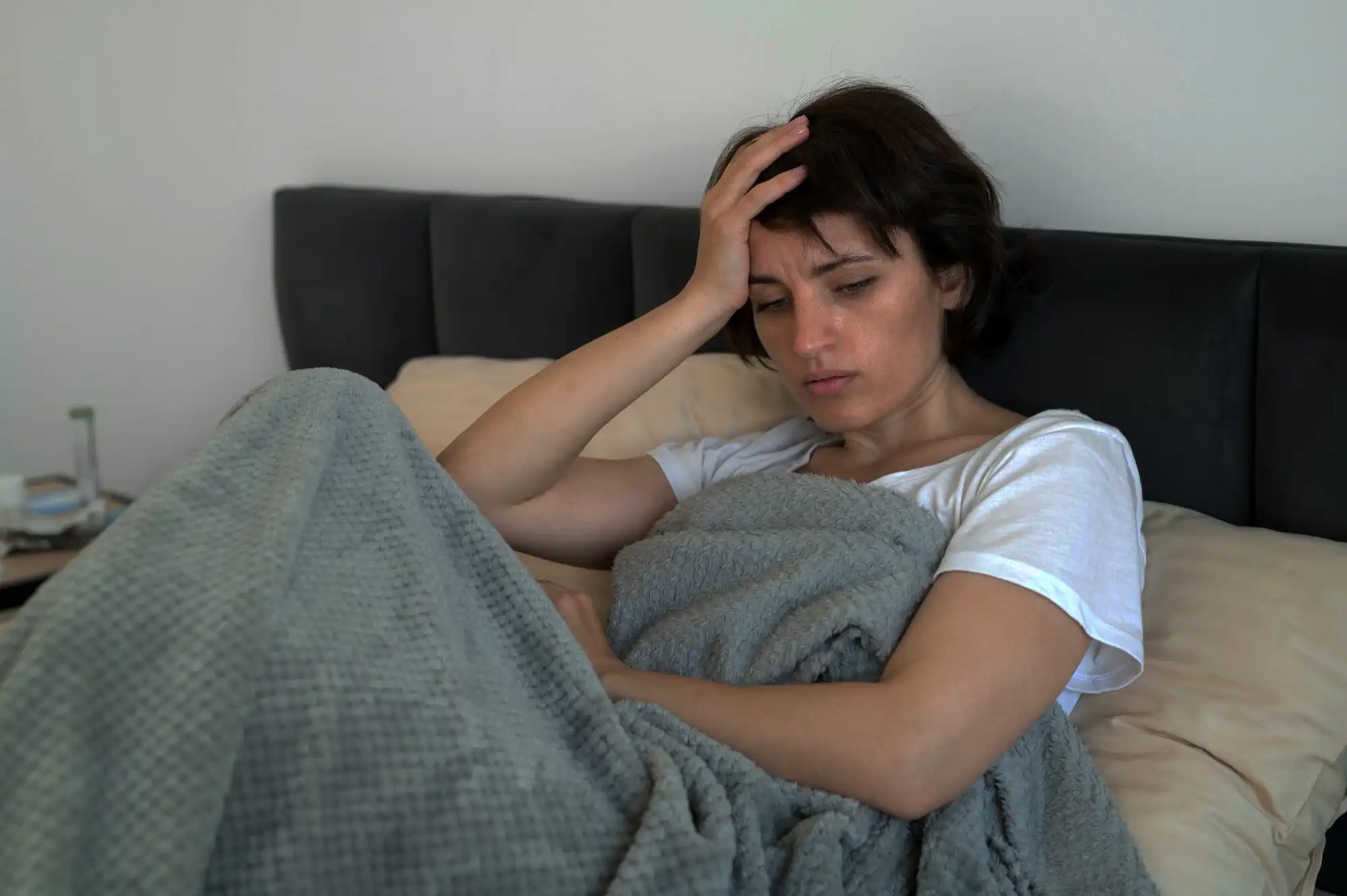
Why do I get night sweats before my period is one of the most frequent ways this question gets asked, and the answer comes down to what happens to progesterone in the second half of your cycle, not to anything going wrong.
After ovulation, progesterone rises and gently nudges your core body temperature up by a few tenths of a degree, that’s actually a normal, expected part of the cycle. In the days just before your period, progesterone then drops sharply as the corpus luteum breaks down. It’s this drop, not the earlier rise, that seems to matter most. The sudden withdrawal disrupts the hypothalamus, the part of your brain that manages temperature regulation, and it overcorrects, triggering the kind of sweating that leaves you kicking off the covers at 3am. Once your period starts and hormone levels reset, the sweating typically settles on its own within a day or two.
Night sweats and chills before periods often show up together rather than sweating alone, and that pairing makes sense given what’s happening physiologically. As your temperature-regulation system overcorrects for the progesterone drop, you can swing from feeling too hot to shivery within the same night, sometimes within the same hour.
Waking up sweating before your period, to the point of needing to change your nightclothes or bedding, sits at the more intense end of what’s still considered a normal PMS presentation for some women. Excessive sweating that’s genuinely disruptive every single cycle is still worth mentioning to your GP, not because it’s necessarily abnormal, but because there are things that can help if it’s affecting your quality of life.
The timing of night sweats before period tends to cluster in a fairly predictable window, which is itself a useful clue for telling PMS-related sweating apart from other causes. Night sweats week before period, night sweats just before period, night sweats day before period, night sweats right before period starts, night sweats before period due, and night sweats 3 days before period are all ways of describing points along the same final stretch of the luteal phase, from about a week out down to the final day or two.
Night sweats week before period fits neatly with the luteal-phase timeline, since progesterone is already elevated and starting its decline roughly seven to ten days before bleeding begins. If your sweating consistently starts around this point each cycle, that timing itself is a reasonably strong indicator of a PMS-related cause.
Night sweats just before period, in the final day or two, tend to be the most intense, since that’s when progesterone withdrawal is sharpest. Night sweats day before period, night sweats right before period starts, and night sweats 3 days before period are all describing this same tail end of the luteal phase, just at slightly different points within it. Night sweats before period due, in that final stretch, is the most commonly reported timing of all.

Age matters here, not because the underlying mechanism changes, but because what else might be going on alongside it does.
Night sweats before period in 20’s are almost always explained by the straightforward luteal-phase pattern described above. Perimenopause isn’t a realistic consideration at this age for the vast majority of women, so if you’re in your twenties, cycle-linked hormonal sweating is by far the most likely explanation.
Night sweats before period in 30s still fit the same PMS pattern for most women, though this is also the decade where some women start noticing very early, subtle shifts if perimenopause happens to begin earlier than average. That’s the exception rather than the rule, most women in their thirties experiencing this are dealing with ordinary premenstrual sweating, not an early hormonal transition.
Night sweats before period in 40s is where the picture genuinely gets more layered. This is the decade when perimenopause most commonly begins, often starting with cycles that shorten from a typical 28 to 32 days down to 24 to 28 days, before periods become more obviously irregular. If your night sweats are changing character around this age, becoming more frequent, more intense, or less clearly tied to the days right before your period, that shift is worth paying attention to rather than assuming it’s the same PMS pattern you’ve always had.
Night sweats before period perimenopause is the search phrase that captures this overlap directly, and there are a few genuine differences worth knowing between the two.
PMS-related night sweats tend to stay tightly linked to the days before your period and vary somewhat from cycle to cycle, some months barely noticeable, other months more obvious. Perimenopausal night sweats, by contrast, tend to become more frequent, more intense, and less predictable in timing, sometimes happening well outside the premenstrual window, and they tend to persist and build over months rather than staying stable cycle after cycle. Up to 80 percent of women going through perimenopause experience some form of hot flush or night sweat, a notably higher figure than the PMS-specific data, and the pattern tends to be more disruptive overall. If you’re in your forties and the picture has shifted from a sweaty night or two before your period to something more frequent and less predictable, that’s a reasonable prompt to bring it up at your GP.
Night sweats period or pregnant is a different question entirely, and it’s worth answering separately rather than folding it into the PMS explanation above.
Pregnancy-related night sweats work through a different mechanism entirely. Rather than the progesterone withdrawal that causes premenstrual sweating, early pregnancy involves rising progesterone and hCG, along with increased blood flow and metabolic rate, all of which can independently cause sweating. So if your period is late, or you’re having night sweats alongside other early signs such as nausea, breast tenderness, or unusual fatigue, a pregnancy test is a sensible next step rather than assuming it’s the usual premenstrual pattern. This isn’t a case of the same cause showing up differently, it’s genuinely a different hormonal picture, which is exactly why it’s worth checking rather than guessing.
Practical steps can meaningfully reduce night sweats before your period every month, even though the underlying hormonal shift itself isn’t something you can prevent entirely.
Most women don’t need medical treatment for this specifically, but if it’s affecting your sleep every cycle, it’s a reasonable thing to raise rather than just living with it.
Most night sweats before a period don’t need medical attention, but a few patterns are worth flagging to your GP rather than monitoring alone. These include sweating that’s become noticeably more frequent or intense over recent months, sweating that’s no longer confined to the days before your period, unexplained weight loss alongside the sweating, or fevers and night sweats together, which points toward a cause unrelated to your cycle and deserves proper assessment.

If night sweats before your period have become disruptive, or the pattern has changed in a way that’s making you wonder about perimenopause, that’s worth a proper conversation rather than guessing from symptoms alone. In our practice, we take a full history of your cycle and symptoms, and talk through whether this fits ordinary PMS, an early perimenopausal shift, or something else worth investigating.
You can read more about how we support women through hormonal changes on our Women’s Health page, and current consultation pricing on our Fees page. To arrange a consultation, get in touch through our Contact Us page, or message us on WhatsApp at +44 7879 710046.
We’re generally available Monday to Friday, 9.30am to 8pm, with online morning appointments on Saturdays.
If you’re experiencing night sweats alongside fever, unexplained weight loss, or symptoms that feel unrelated to your cycle, that’s worth prompt medical attention rather than waiting to see if it settles.
Yes, for most women it’s a normal part of the luteal phase, linked to the progesterone drop that happens in the days before bleeding starts. It typically resolves on its own once your period begins.
They can, particularly if the pattern has changed, becoming more frequent, more intense, or less clearly tied to the days right before your period. In your forties especially, that shift is worth mentioning to your GP, though occasional premenstrual sweating on its own doesn’t necessarily mean perimenopause has started.
Hormone levels fluctuate somewhat from cycle to cycle even in women with otherwise regular periods, which is why PMS symptoms, including night sweats, can vary in intensity month to month rather than being identical every time.
A cool bedroom, breathable bedding, cutting back on alcohol and caffeine in the evening, and staying hydrated all help reduce intensity for most women. If sweating is disrupting your sleep most cycles despite these steps, it’s worth discussing further options with your GP.
Webdesign by EyeMedia Creative