



Last Updated: September 12th, 2026
Reading Time: 8 mins
Yes, menopause and urinary tract infections are genuinely linked, and it isn’t in your head or down to bad luck. Falling oestrogen changes the tissue lining your bladder and urethra, thins the vaginal wall, and shifts the bacterial balance that normally keeps infection-causing bugs in check. The result is that recurrent UTIs become far more common from perimenopause onward, and for some women they start for the first time in their late forties or fifties, seemingly out of nowhere. In our clinic, this is one of the most common and most under-discussed complaints we see in women going through this transition. This piece walks through why it happens, what the current evidence says about prevention, and what to do if it’s already become a pattern for you.
Menopause and urinary tract problems share a single root cause: oestrogen decline. It’s rarely framed this way to patients, which is part of why so many women assume each infection is an isolated, unlucky event rather than part of a pattern tied to their hormones.
Studies tracking women through the menopause transition show recurrent UTI rates climb from roughly 19 to 36 percent before menopause to around 55 percent afterward. That’s not a marginal increase, it’s more than a doubling in some cohorts. Menopause urinary infections tend to cluster because the underlying tissue changes don’t resolve between episodes the way they might in a younger woman with a one-off infection from, say, dehydration or a new sexual partner. Once the vaginal and urethral environment shifts, UTI symptoms can keep returning until that environment is addressed directly, not just treated with another course of antibiotics each time.
Genitourinary syndrome of menopause is the umbrella term for the changes that oestrogen decline causes across the vulva, vagina, urethra and bladder, and it’s the direct answer to why menopause causes UTIs so often after 45.
Here’s the mechanism in practical terms. Oestrogen keeps the vaginal lining thick, well supplied with glycogen, and populated by lactobacilli, the “good” bacteria that keep vaginal pH acidic and inhospitable to E. coli and other UTI-causing organisms. As oestrogen falls, glycogen stores shrink, lactobacilli numbers drop, and vaginal pH rises from its normal acidic range toward neutral. A 2026 systematic review of the postmenopausal vaginal microbiome found something slightly more nuanced than “fewer good bacteria”: postmenopausal women don’t just lose lactobacilli, they also show a rise in bacterial-vaginosis-associated anaerobes and gram-positive uropathobionts, organisms more capable of colonising the urinary tract. The urethra itself also thins and shortens its distance from bacterial sources, which makes ascending infection easier mechanically, not just biochemically.
Yes. Do you get more UTIs during menopause is one of the most searched versions of this question, and the honest answer is that most women going through this transition will notice either their first UTI in years or a return of infections they thought they’d outgrown after their twenties.
This isn’t universal, some women sail through menopause without any urinary symptoms at all, but it’s common enough that we treat it as an expected part of the conversation rather than an unusual complaint. If you’ve had two or more UTIs in six months, or three or more in a year, that crosses the clinical threshold for “recurrent,” and it’s worth a proper conversation about prevention rather than repeat rounds of antibiotics.
This is a distinction that gets missed constantly, including in some GP consultations. Can menopause cause UTI symptoms without a true bacterial infection being present? Yes, and it’s a genuinely important nuance.
Genitourinary syndrome of menopause causes urgency, a burning sensation when you urinate, a feeling of incomplete emptying and general urinary discomfort, all without any bacteria growing on a urine culture. These symptoms overlap almost completely with an actual UTI, which means women sometimes end up on repeated courses of antibiotics for a hormonal tissue problem that antibiotics can’t fix. If you’ve had several “UTIs” where the urine dipstick or culture came back clean, or where symptoms resolved on their own within a day or two, that pattern points toward GSM rather than true infection, and it changes the treatment plan considerably.
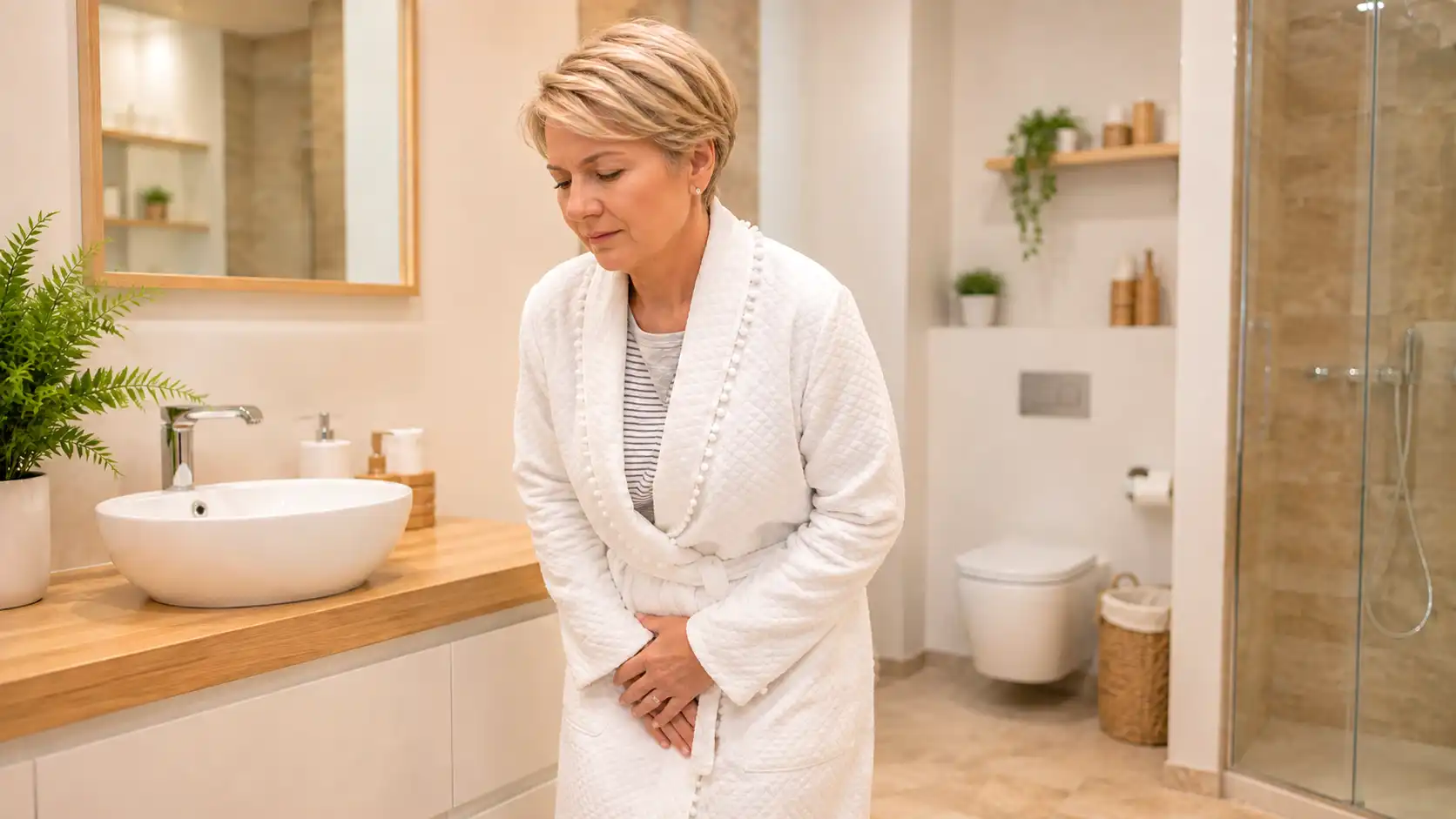
UTI symptoms in perimenopause can start well before periods actually stop, which surprises a lot of women who assume urinary changes only begin at menopause itself.
Oestrogen doesn’t decline in a straight line during perimenopause, it fluctuates, often dropping sharply in the later stages of the transition even while periods are still happening. Perimenopause and UTI risk rise together during these lower-oestrogen windows, and because periods are often still present, women don’t always connect increased UTI frequency to a hormonal cause. If you’re in your early-to-mid forties, still having periods, but noticing more urinary infections than you used to, perimenopause is a reasonable explanation worth raising with your GP.
UTIs after menopause don’t automatically settle down once periods have fully stopped, and for many women it’s the opposite, symptoms build gradually as oestrogen deficiency deepens over the postmenopausal years.
Urinary tract infections after menopause tend to be more persistent than perimenopausal ones because the tissue changes are more established by this stage. This is also the group where genitourinary syndrome of menopause is most prevalent, affecting roughly half to seventy percent of postmenopausal women to some degree, even if not every case is severe enough to prompt a GP visit. The good news is that this is also the group with the clearest evidence behind treatment, which is where vaginal oestrogen comes in.
Vaginal estrogen for UTIs has the strongest evidence base of any preventive option we discuss with patients, and it works by addressing the cause directly rather than treating each infection as it arises.
In one placebo-controlled trial, 95 percent of women using vaginal oestrogen were UTI-free at four months compared with 30 percent on placebo, and the median UTI rate over the full follow-up period was 0.5 infections per patient-year on treatment versus 5.9 per patient-year on placebo. That’s a substantial difference, and it reflects what vaginal oestrogen actually does physiologically: it restores glycogen to the vaginal lining, allows lactobacilli to recolonise, brings vaginal pH back down, and thickens the urethral and vaginal tissue. NICE’s guidance on recurrent UTIs recommends considering vaginal oestrogen for postmenopausal women when hygiene and behavioural measures alone haven’t been enough, though it notes this remains an off-label use and that benefit can diminish if treatment is stopped. It’s available as a cream, gel, pessary or vaginal tablet, and it’s used locally rather than systemically, so it doesn’t carry the same considerations as oral or transdermal HRT. As with any hormone-based treatment, individual suitability needs to be assessed properly, particularly for women with a personal history of breast cancer, which is why this is a conversation to have directly with your doctor rather than a self-directed decision.
Preventing urinary tract infections after menopause without antibiotics is possible for a meaningful proportion of women once the hormonal driver is addressed, though it’s worth being realistic that not every case resolves without any medication at all.
Vaginal oestrogen is the most evidence-backed non-antibiotic option, but it isn’t the only one. Vaginal moisturisers used regularly (not just around intercourse) can support tissue health between oestrogen applications. Emerging research on vaginal probiotics containing specific lactobacillus strains shows some promise for recolonising the vaginal microbiome, though a 2026 review found the trial evidence still mixed, with cohort studies more positive than randomised trials. Cranberry supplements have modest evidence at best and shouldn’t be relied on alone if you’re having genuinely recurrent infections.
Menopause UTI prevention also comes down to a handful of practical daily habits that support what medical treatment is doing, rather than replacing it.
None of these replace addressing the underlying oestrogen deficiency if that’s the driver, but combined with vaginal oestrogen they meaningfully reduce how often infections recur for most women.

If UTIs have become a recurring part of your life since perimenopause or menopause began, that’s a pattern worth investigating properly rather than managing one antibiotic course at a time. In our practice, we take a full history, rule out true infection versus GSM-driven symptoms where needed, and talk through whether vaginal oestrogen or another approach fits your situation, including your personal and family health history.
You can find more on how we approach hormonal and urinary symptoms through menopause on our Women’s Health page, and current consultation pricing on our Fees page. To book a consultation, use Book An Appointment directly, or message us on WhatsApp at +44 7879 710046.
We’re generally reachable Monday to Friday, 9.30am to 8pm, with online morning appointments available on Saturdays. For anything you’d rather put in writing first, our Contact Us page has a form and our direct details.
If you’re currently mid-infection with fever, back or flank pain, or blood in your urine, that needs same-day medical attention rather than waiting for a routine appointment, so please seek urgent care in that situation.
Both. Vaginal oestrogen was originally associated with dryness and discomfort, but the same mechanism, restoring vaginal tissue and lactobacilli, is what gives it a genuine preventive effect against recurrent UTIs, supported by trial data showing meaningfully lower infection rates on treatment versus placebo.
Systemic HRT (tablets, patches or gels) doesn’t have the same direct evidence for UTI prevention that local vaginal oestrogen does, because it doesn’t concentrate oestrogen at the vaginal and urethral tissue in the same way. Some women on systemic HRT still need local vaginal oestrogen added separately if UTIs remain a problem.
Not necessarily, and this is worth discussing with your GP directly. If symptoms are confirmed as a true infection on testing, antibiotics are usually appropriate for that episode, but for prevention going forward, addressing the underlying GSM with vaginal oestrogen often reduces how often you need antibiotics at all.
If you’ve had two or more UTIs in six months or three or more in a year, or if you’re getting UTI-like symptoms repeatedly with negative urine tests, both patterns are worth a proper GP review rather than continuing to treat each episode in isolation.
Webdesign by EyeMedia Creative