


Last Updated: November 16th, 2026
Reading Time: 11 mins
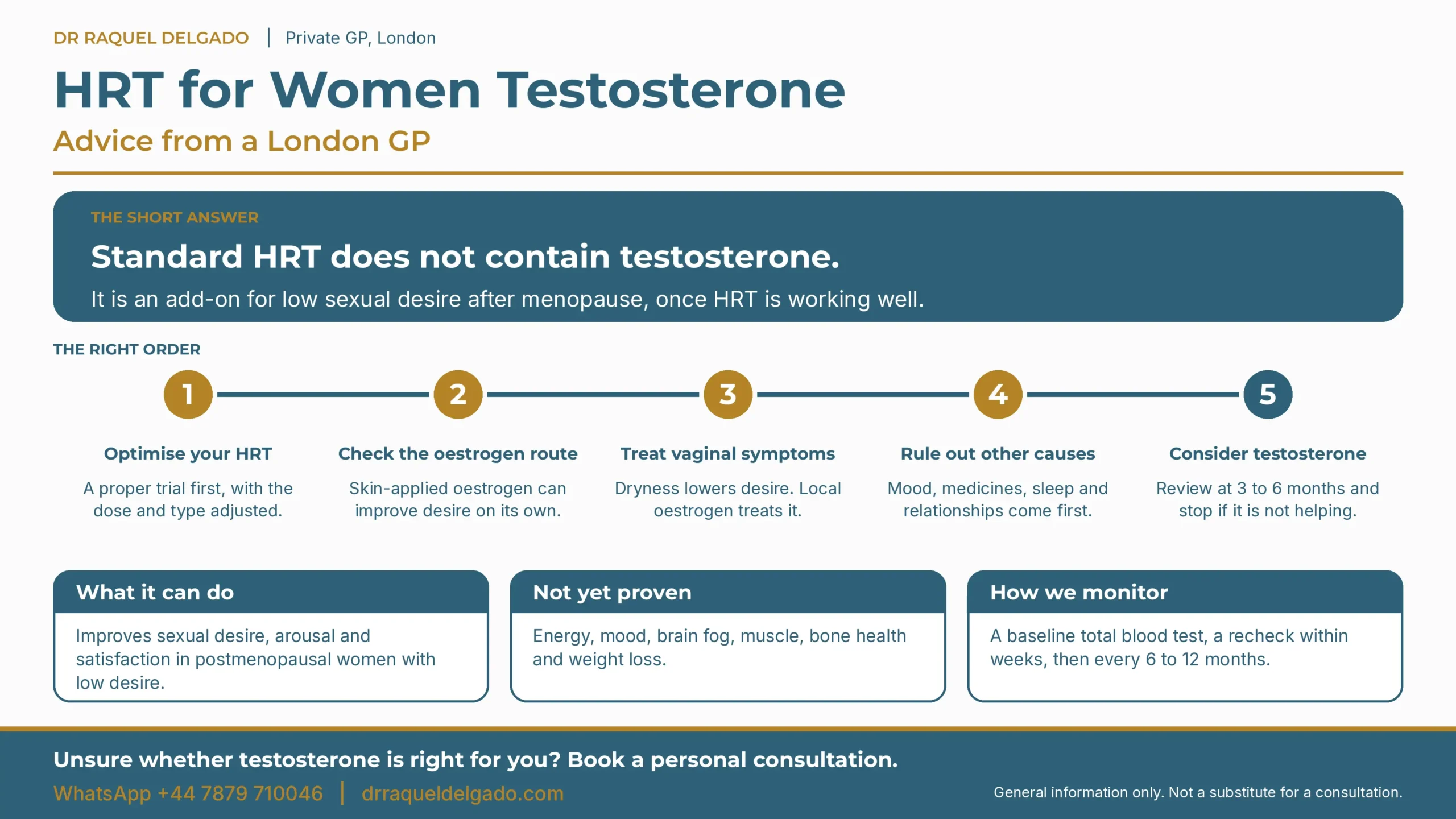
HRT for women testosterone advice starts with one fact: standard HRT does not contain testosterone. Testosterone is an add-on we consider for low sexual desire after menopause, once your HRT is working well and other causes have been ruled out.
That order matters, because testosterone helps one problem well and the evidence for other claims is thin. This guide explains what HRT includes, when testosterone makes sense, what it can and cannot do, how we monitor it, and the safety points we cover first.
Key takeaways
No. Standard HRT does not contain testosterone. HRT therapy replaces the hormones that fall at menopause. The main one is oestrogen. Women who still have a womb also take a progestogen, which protects the womb lining from the thickening that oestrogen alone can cause.
Oestrogen comes as patches, gels, sprays or tablets. Some women take the progestogen for part of each month, and others take both hormones every day. Testosterone is a separate treatment, added on top when there is a clear reason. One oral HRT option is weakly androgenic, which means it has a mild testosterone-like effect, but that does not make it testosterone therapy.
You may also see compounded “bioidentical” mixes sold as HRT for women menopause care. National guidance does not recommend them, because they have not been tested the way licensed medicines are. Licensed body-identical products can give the same benefits.
HRT benefits start with hot flushes and night sweats, where oestrogen is the most effective treatment. It also eases vaginal dryness and urinary symptoms, often improves sleep, and can settle joint aches. HRT helps protect bone too, although it is not usually started for bone protection alone.
How long does HRT take to work? Some women notice a change within a few weeks, and the full effect can take up to three months. We review you at three months, and then at least once a year. Early side effects such as breast tenderness or bloating usually settle by that first review.
HRT is not prescribed to protect the heart or prevent dementia, and it carries risks as well as benefits. We go through both with you before you start, and hormone therapy is not the right choice for every woman. Everyone deserves clear, evidence-based information on their symptoms, options, benefits and risks, so they can make an informed decision.
Not necessarily, but timing changes the balance. HRT after menopause works best when you start before 60, or within about 10 years of your last period. In that window the balance of benefit and risk is most favourable.
Starting later is not ruled out. It needs a closer look, because that balance shifts with age. If you are past that window, we weigh your symptoms, your health history and the type of HRT before deciding. Skin-applied oestrogen is usually preferred for women over 60.
Testosterone is considered when low sexual desire continues after menopause and HRT alone has not helped. The NICE guideline supports this, and the British Menopause Society treats it as the one clearly proven use. The medical term is hypoactive sexual desire disorder, which means a lasting loss of desire that causes you distress.
This is testosterone as part of HRT in the sense that it is added to an HRT plan, never swapped in for it. Women make testosterone in the ovaries and adrenal glands, and levels fall with age. A low blood level on its own is not a reason to treat. Many women with low levels have no symptoms, and many with low desire have normal levels.
Low desire has many causes, including relationship strain, low mood, stress, poor sleep and some antidepressants. We look at these first. Testosterone for menopause is not a quick fix for any of them.
The sequence matters, and skipping steps is the most common mistake. We usually work through four steps.
Testosterone therapy for menopause has one proven job. Trials show it improves sexual desire, arousal and satisfaction in postmenopausal women with low desire. Beyond that, the evidence is much weaker.
| What the evidence supports | What is not yet proven |
| Higher sexual desire after menopause | Better energy and less tiredness |
| Greater arousal and pleasure | Improved mood or less anxiety |
| More satisfying sex | Less brain fog |
| Benefit judged over three to six months | Stronger muscles and bones |
| Works best alongside well-optimised HRT | Weight loss |
Some women tell us they feel more energetic or clearer in the head, and we take that seriously. The trials so far have not confirmed those benefits, and a UK trial of 400 women is under way to test them.
Testosterone for low libido in women works best when hormonal desire loss is the cause. Most women who respond notice a change within three to six months, which is why we judge the result at that point and stop if there is no benefit. If HRT is not working for libido, the next step is a careful look at the whole picture, not an automatic prescription.
Testosterone is not suitable for everyone. We avoid it in pregnancy, breastfeeding and active liver disease. A past hormone-sensitive breast cancer needs specialist input and is usually not advised. Competitive athletes need extra care to keep levels well within the female range. We also hold off if your starting level is already high.
Side effects are uncommon when levels stay in the normal female range. The most common are extra hair growth, acne and some weight gain, which usually ease when the dose is lowered or stopped. Rarer effects include hair thinning, a deeper voice and clitoral enlargement. Our post on HRT side effects covers the oestrogen and progestogen part.
HRT long term effects depend on the type, the dose and how long you take it. The aim is the lowest dose that controls your symptoms, reviewed every year, and no single time limit applies to everyone.
The best-known concern is breast cancer. Oestrogen alone adds a small extra risk, combined HRT adds slightly more, and the risk grows with the years you take it. Some raised risk can persist after stopping. Vaginal oestrogen has not been linked to an increase. Your own baseline risk, the type of HRT and the length of use all matter, so we go through the figures that apply to you.
Other effects are more specific. Oestrogen swallowed as a tablet raises the risk of blood clots, while skin-applied oestrogen does not raise it above normal, so we prefer it if you have clot risk factors. Oestrogen alone thickens the womb lining, which is why women with a womb always take a progestogen too.
For testosterone, long-term data on heart and breast outcomes are limited, though short-term results are reassuring.
Treatment starts with a total testosterone blood test, which measures all the testosterone in your blood. It gives us a baseline and confirms your level is not already high. We use the total figure, not free or calculated versions, because it is the clearest guide to your response. The test does not decide whether you have low desire. Your symptoms do that.
| When | What we do |
| Before starting | Baseline total testosterone blood test and a full history |
| About 3 to 6 weeks, often 2 to 3 months | Recheck the level, review benefits and side effects |
| 3 to 6 months | Judge whether it is helping, and stop if it is not |
| Every 6 to 12 months | Repeat the level to keep it in the female range |
| At least yearly | Review your HRT and testosterone together |
Female-dose testosterone does not need routine blood count or cholesterol checks. HRT itself is reviewed at three months and then at least every year, as the NICE guideline sets out, and our post on the yearly HRT review explains what happens.
Off-licence prescribing means a medicine is used in a way its licence does not list. It is legal and common, and professional guidance supports it when the evidence and experience are there. Most testosterone given to women in the UK is licensed for men and used at much smaller doses, usually about a tenth of the male amount.
One testosterone cream made for women has been granted UK authorisation, conditional on a pump pack being available, which is hoped for in 2026. Until then it is still imported privately under a special licence, and most other products remain off-licence for women. We explain which product we are using, why, and what it means for you. We use regulated products and never compounded mixes, because regulators and menopause societies advise against them.
Some signs need attention without delay:
If any of these apply, contact us straight away so we can arrange to see you quickly. Our same-day appointments are there for exactly this.
Dr Raquel Delgado starts with a conversation, not a prescription. She asks what you are feeling, when it began, how your periods and hormones have changed, and what you already take. A clear history often shows that HRT needs adjusting before testosterone is even discussed.
This approach comes from seeing both sides of the consultation. Dr Delgado began hormone therapy seven years ago, after perimenopause and menopause changed her own quality of life. Even as a doctor, she did not fully grasp how much they could affect a woman’s life until she lived it. She knows what it is like to no longer recognise yourself and to wonder whether you will feel like yourself again. She also believes women’s hormonal health remains undervalued in medicine, which is why she talks about it so openly and wants better education on menopause across every medical specialty.
From there we check your blood pressure, review your medicines and arrange the blood tests that fit your history. Where HRT is the right first step, we set it up and review it at three months. Where testosterone may help, we cover the benefits, limits, side effects and monitoring plan, so you can decide with the facts in front of you. Our women’s health care page explains how we support women through perimenopause and menopause.
A short diary helps. For four weeks, note your symptoms, sleep, mood and desire, and list every medicine you take. Our Consultation Toolkit has short guides on what to bring and what to ask, and our Wellness Library has free resources on everyday wellbeing.
There is no single best HRT. The right choice depends on your symptoms, whether you have a womb, your clot and cancer risk factors, and how you tolerate each hormone. Skin-applied oestrogen is often preferred if you have clot risk factors or are over 60. We tailor it to you and review it as you go.
HRT itself does not appear to cause weight gain. Midlife weight changes mostly come from ageing, muscle loss and poor sleep, and fat shifts towards the middle after menopause. Some progestogens cause temporary fluid retention early on. Our post on menopause weight gain and our weight management support cover the rest.
At three months after starting, then at least once a year. We review sooner if you have side effects, your symptoms return or you notice unexpected bleeding. Each review checks that the dose still suits you and that the benefits still outweigh the risks.
Yes, and that is the usual way to take it. Testosterone is added to a stable HRT plan for low sexual desire that HRT alone has not fixed. Taking it without oestrogen is not usually advised, because acne and hair growth are more common.
Yes, for many women with distressing low desire after menopause, once HRT is optimised. It does not help everyone, and it can take three to six months to judge.
Side effects are uncommon at the right dose. The most common are extra hair growth, acne and some weight gain, which are usually reversible. A deeper voice or hair thinning is rare.
Yes, before starting and at regular checks afterwards, to keep levels in the female range. The test does not diagnose low desire, so your symptoms guide the decision.
This article is general information and not a substitute for a personal consultation. If you have questions about HRT or testosterone, please speak with us.

Dr Raquel Delgado is a private GP in London with more than 20 years of clinical experience in general practice, women’s health, and hormonal care. She has a particular focus on doctor-led, natural-looking aesthetic treatments for women, and consults in both English and Spanish. Every consultation is with Dr Delgado personally, giving you the same clinician’s judgement and continuity of care each time.
For HRT and testosterone, we begin with a full history, a review of your current treatment and the right blood tests, then explain your options clearly. We prescribe HRT in line with national guidance, consider testosterone where it is appropriate, and review everything on a clear schedule. You can read about our practice and see the consultation fees in advance. To arrange a consultation, contact us or reach out using the details below.
If you have bleeding after menopause, a new breast lump, or pain and swelling in one calf, contact us straight away so we can arrange to see you quickly.