

Last Updated: November 16th, 2026
Reading Time: 10 mins
Clitoral pain after menopause is most often caused by falling oestrogen, and in that case HRT often helps, especially vaginal oestrogen applied straight to the tissue. It does not help every cause, though. Skin conditions, nerve pain, infection and tight pelvic floor muscles can feel the same and need different treatment.
Sorting out which one you have is the first step, and it is how Dr Raquel Delgado approaches every case. Women often hesitate to mention this symptom, even though it is common and treatable. Below, we explain the causes, show where HRT fits and where it does not, and set out the signs that need prompt attention.
Oestrogen keeps the skin of the vulva and clitoris plump, soft and well supplied with blood. The vulva is the outer part of the genitals. After menopause, which means 12 months since your last period, oestrogen falls to very low levels. The tissue thins, dries and becomes easier to irritate.
This group of changes is called genitourinary syndrome of menopause, or GSM. It also affects the vagina, bladder and urethra, so some women notice urinary symptoms such as stinging or repeated infections alongside the soreness.
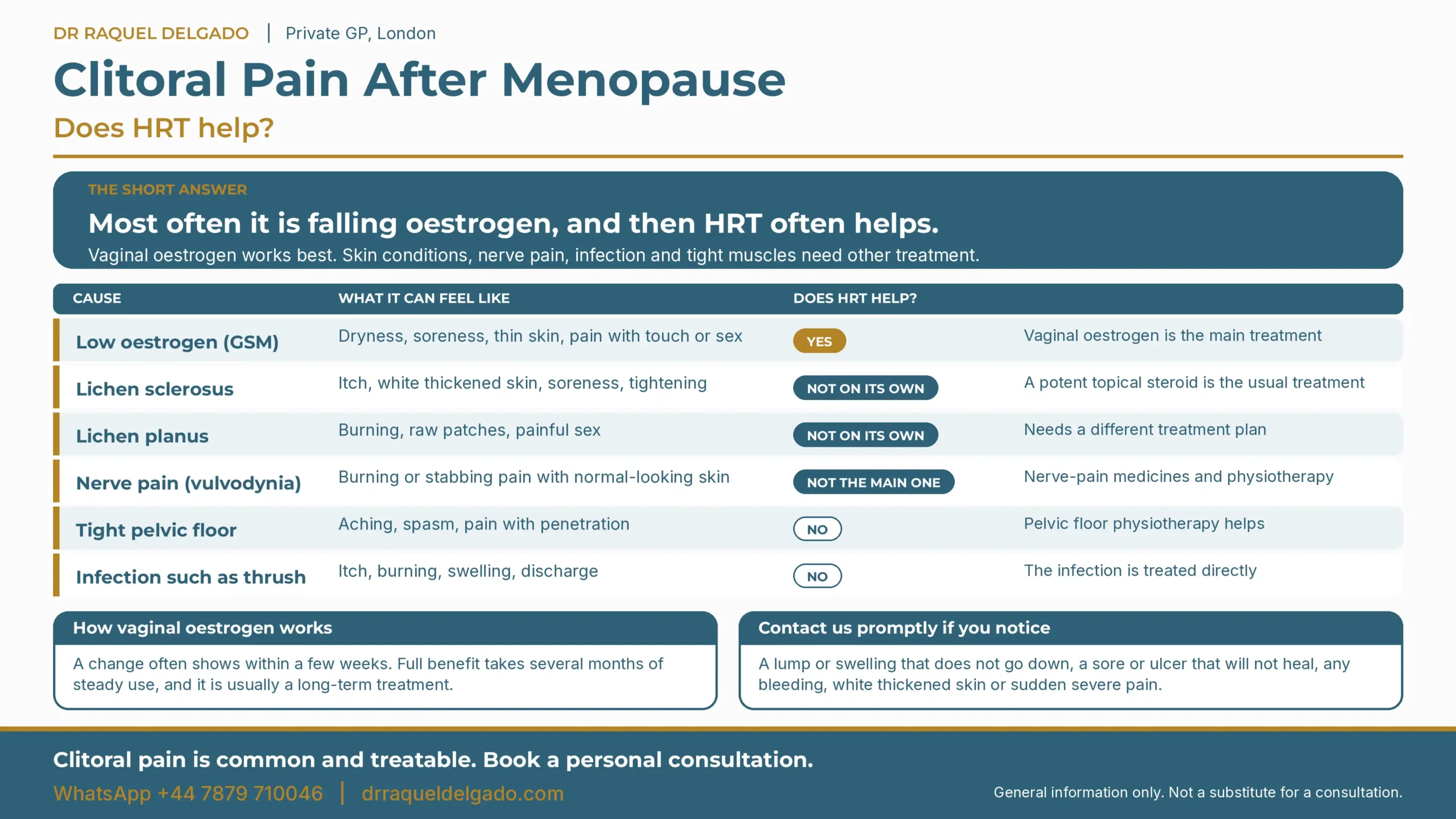
Low oestrogen is the most common cause of clitoral pain after menopause, but it is not the only one. Skin conditions, nerve pain, infection, tight pelvic floor muscles and reactions to soaps or wipes can all play a part. We compare them in a table further down.
Symptoms may not start until several years after your last period, which catches many women out. They can also begin earlier, in perimenopause, when oestrogen is already falling unevenly. Because the change is gradual, it tends to worsen without treatment rather than settle by itself.
Some women reach this point sooner and more sharply. Menopause that follows surgery, and breast cancer treatments that lower oestrogen, can bring symptoms on earlier and make them stronger. If either applies to you, tell us at the start, as it shapes which treatments are suitable.
Atrophy means thinning and shrinking of tissue. With clitoral atrophy, the skin over and around the clitoris becomes thinner and loses some of its cushioning. Blood flow to the area also falls, so the skin repairs itself more slowly. Everyday friction from underwear, trousers or toilet paper can then feel sharp or raw.
The changes differ from woman to woman. Some notice burning and soreness, some feel the area has become numb or less responsive, and some have both at different times. The clitoris itself may look smaller or less visible as the hood tightens over it.
Here is a common pattern, described as an example rather than one patient. A woman a few years past her last period starts to feel a raw, stinging soreness when she sits on a hard seat or pulls on jeans. She assumes it is thrush, buys over-the-counter treatments and gets no relief. The cause is thin, unprotected skin, and no antifungal will fix that.
This is why Dr Delgado examines the area carefully before recommending anything. Atrophy can look similar to other skin conditions, and the right treatment depends on telling them apart.
The clitoral hood is the small fold of skin that covers the clitoris. When oestrogen drops, the hood can thin and tighten, and the skin underneath can stick or trap dead skin cells. These form small hard lumps that feel tender. Clitoral hood pain can flare with tight clothing, cycling or sex, and it may come with a feeling of pulling or pressure.
If the hood has become stuck down over the clitoris, gentle self-examination with a mirror can show whether the skin looks pale, tight or swollen, and that description helps us when we examine you.
Some women feel nothing until something touches the area, such as wiping after the toilet, washing or underwear that rubs. Clitoral pain when touched can come from thin, fragile skin, and the soreness spreads over the whole area. A sharper, more pinpoint reaction to even light contact, with normal-looking skin, points more towards irritated nerves.
Noting exactly what sets the pain off gives us a useful clue. A few days of notes covering the time of day, the trigger and how long the pain lasts are enough to show a pattern.
Heightened sensitivity feels like burning, stinging or rawness, sometimes even from water or a light breeze. Clitoral pain sensitivity has several possible sources. Low oestrogen is one. Irritants are another, including scented wash, wipes, fabric conditioner and some creams. Overactive nerves are a third.
While we investigate, plain water for washing, a fragrance-free emollient and cotton underwear take the pressure off the skin. Sensitivity that comes on suddenly after a new product settles once the product stops, whereas sensitivity that builds over months fits a hormonal or nerve cause better and deserves an assessment.
Painful intercourse after menopause affects a large number of women, and clitoral soreness is often part of it. The same thinning and dryness that make the clitoris tender also make the entrance to the vagina less stretchy and less lubricated. Women commonly describe:
Pain can also set off a cycle. When you expect it, the pelvic floor muscles tighten without you meaning to, and that tightness adds a second source of pain. Treating the dryness early helps break the cycle. Lubricant during sex and a regular vaginal moisturiser can ease symptoms, but neither reverses the thinning, so the cause itself needs treating as well. You do not have to accept painful sex as an inevitable part of ageing.
Small practical steps help while treatment takes effect. Allow more time before penetration, use a generous amount of water-based lubricant, and tell your partner what hurts so you can adjust together. Stop if pain builds, because pushing through it tightens the muscles further. Once the pain is treated, desire and comfort can improve together.
Clitoral pain and swelling together suggest inflammation or a local problem rather than simple dryness. Common causes include irritation or an allergic reaction to a new product, thrush or another infection, dead skin cells trapped under the hood, and skin conditions such as lichen sclerosus. Swelling that settles within a few days of stopping a new product is most likely irritation.
When we examine you, we look at the colour and texture of the skin, whether the hood moves freely, whether there is a lump under it, and whether the pain matches the area that looks inflamed. Those findings tell us whether this is an irritation, an infection or something that needs further tests.
Swelling that lingers needs a proper look. Please get in touch if you notice any of the following:
Contact us straight away so we can arrange to see you quickly.
In most women it does, provided low oestrogen is the cause. The most direct option is vaginal oestrogen, available as a cream, pessary, tablet or ring. It delivers oestrogen to the vagina and vulva, and very little reaches the bloodstream. That makes it different from whole-body HRT, which uses patches, gels or tablets to treat hot flushes and sleep problems as well. Some women on whole-body HRT also need local oestrogen, because genital tissue may not respond fully to it alone.
A change often shows within a few weeks. Full benefit can take several months, so we ask for steady use before judging how well it is working.
We show you exactly where and how to apply it, as the right spot differs for dryness inside the vagina and for soreness on the outer skin. The schedule depends on the product, and we write it out for you so there is no guesswork. Symptoms return in most women if treatment stops, which is why local oestrogen is normally a long-term treatment, and we look at it again at your yearly HRT review.
Before starting, we go through your history, including any breast cancer or unexplained bleeding, because bleeding after menopause needs investigating first. If oestrogen is not suitable, or has not been enough, there are non-oestrogen prescription options, and moisturisers and lubricants still help day to day. We go through which fit your history. The same approach suits vaginal dryness that starts earlier, in perimenopause. It sits within our wider menopause care.
If you have used vaginal oestrogen regularly for a few months and the pain has not eased, another cause is likely. That is a reason to look again, not to stop. It is also common to have more than one cause at once. For example, a woman with thin, dry tissue may also have a tight pelvic floor from months of guarding against pain, and treating only the hormone side leaves half the problem in place.
| Cause | What it can feel like | Does HRT help? |
| Low oestrogen (GSM) | Dryness, soreness, thin skin, pain with touch or sex | Yes, vaginal oestrogen is the main treatment |
| Lichen sclerosus | Itch, white thickened skin, soreness, tightening | Not on its own. A potent topical steroid is the usual treatment |
| Lichen planus | Burning, raw patches, painful sex | Not on its own. Needs a different treatment plan |
| Nerve pain (vulvodynia) | Burning or stabbing pain with normal-looking skin | Not the main treatment. Nerve-pain medicines, physiotherapy and psychosexual support are used |
| Tight pelvic floor muscles | Aching, spasm, pain with penetration | No. Pelvic floor physiotherapy helps |
| Infection such as thrush | Itch, burning, swelling, discharge | No. The infection is treated directly |
Lichen sclerosus and lichen planus are skin conditions that need examination, sometimes a small skin sample, and regular follow-up, because untreated lichen sclerosus carries a small long-term skin cancer risk. Vulvodynia means vulval pain lasting at least three months with no clear cause. It is diagnosed once other causes have been ruled out.
We start by listening. When did it begin, what sets it off, does it burn or stab, and what products, medicines and routines are involved? We also ask about periods, bladder symptoms and sex, as these shape the picture.
Next comes a gentle examination, with a chaperone offered. We look for thinning, redness, white patches, splits, trapped skin under the hood and signs of infection. If infection is possible, we take a swab. Blood tests are used only when they would change the plan, and any skin that looks unusual is referred for a biopsy. We arrange the tests and coordinate referral to a skin specialist, gynaecologist or pelvic health physiotherapist when needed, and we stay involved throughout.
We review progress after about three months of treatment, because that is long enough to judge whether the plan is working or the diagnosis needs revisiting.
Our aim is that you leave with a clear plan, whether that is vaginal oestrogen, a treatment for another cause or both. As a private GP service, we offer same-day appointments where we can. Our fees are set out openly, and the Wellness Library and resources hold further reading.

Dr Raquel Delgado is a private GP in London with more than 20 years of clinical experience in general practice, women’s health and hormonal care. She has a particular focus on doctor-led, natural-looking aesthetic treatments for women, and consults in both English and Spanish. Every consultation is with Dr Delgado personally, giving you the same clinician’s judgement and continuity of care each time.
For clitoral pain, we take a full history, examine the area, work out which cause or causes are involved and agree a treatment plan with you. That can include vaginal oestrogen, whole-body HRT, treatment for another condition or referral, all coordinated from our practice. To arrange a consultation, contact us or reach out using the details below.
If you have a lump, an ulcer that will not heal, bleeding or sudden severe pain, contact us straight away so we can arrange to see you quickly.
Yes. Falling oestrogen thins and dries the skin around the clitoris, and that is the most common reason for soreness after menopause. It is not the only reason, so we check for skin conditions, nerve pain, infection and pelvic floor tension before assuming hormones are responsible.
The tissue can be improved in many cases, though how much varies. Regular vaginal oestrogen can restore thickness, moisture and comfort for a good number of women, and pain eases as the skin recovers. Changes in shape, such as a tighter hood, may not fully return, and treatment has to continue to keep the benefit.
Improvement can start within a few weeks. Full benefit can take several months of steady use. If there is no improvement after that, we look for another cause.
In general, yes. It acts locally and very little reaches the bloodstream, and it can be used long term. We go through your history first, including any breast cancer, and a personal discussion matters in that situation. Unexplained bleeding is investigated before treatment starts.
Soon, if it lasts more than a few weeks, keeps coming back or affects sex, sleep or daily comfort. Swelling, a lump, an ulcer, bleeding or sudden severe pain need prompt attention, so contact us straight away so we can arrange to see you quickly.
This article is general information and not a substitute for a personal consultation. If you are worried about clitoral pain, please speak with us.