

Last Updated: September 12th, 2026
Reading Time: 9 mins
It depends on the type. Some hair loss in menopause is temporary and grows back once the trigger settles, while a more common pattern is more lasting and needs a different approach entirely. Telling the two apart matters, because the outlook and the options are quite different for each.
If your hair has been thinning, shedding more than usual, or your parting seems wider than it used to be, this guide explains what’s actually happening, how to tell the two patterns apart, how it’s actually diagnosed, and what helps.
Menopause and thinning hair go together far more often than most women expect, and it isn’t just in your head. As oestrogen levels fall, the relative effect of androgens (male-type hormones that are present in everyone, just usually balanced out by oestrogen) becomes stronger, and this can shorten the growth phase of each hair strand. The result is hair that’s finer, sheds a little more, and takes longer to grow back to its previous length.
Do you lose hair during menopause? Most women do, to some degree, even if it’s subtle enough that only you notice it. A small amount of extra shedding, particularly around the temples or through the crown, is common enough during this transition that it’s considered a normal, if unwelcome, part of it for many women.
Does hair fall out in menopause for every woman, though? No, not to the same degree. Genetics play a large role in who’s affected and how much, which is why two sisters going through menopause at similar ages can have very different experiences with their hair. If noticeable thinning runs in your family, on either side, that’s often a useful clue to what you might expect.
Hair fall after menopause and hair loss during menopause are often used interchangeably, and clinically they usually do describe the same underlying picture, changes driven by the shifting hormonal balance of this life stage. The timing can vary though, some women notice changes starting in perimenopause, years before their periods stop, while others notice little difference until well after menopause itself.
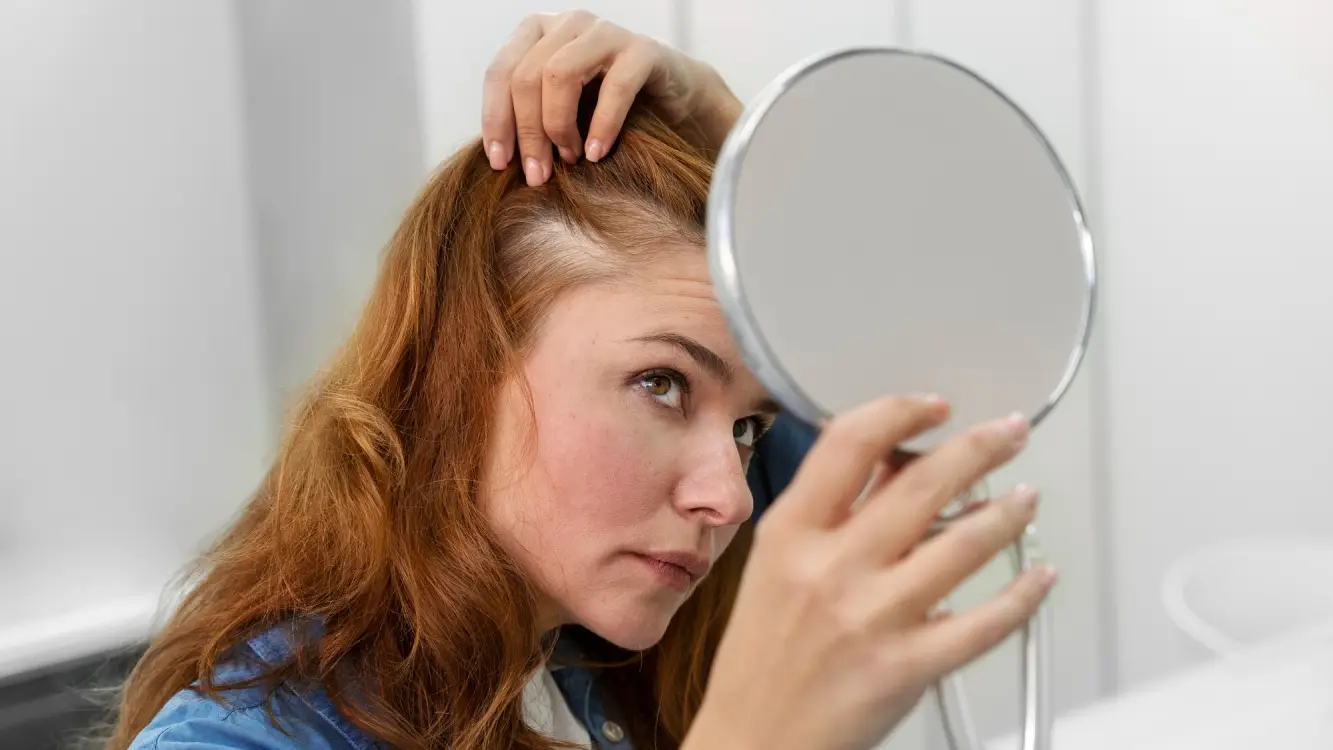
Androgenetic alopecia women experience is the actual clinical name for the most common pattern of hair thinning at this life stage, sometimes referred to more informally, if a little dramatically, as menopause balding. That word can sound alarming, but it’s worth being clear from the outset: this pattern is almost always diffuse thinning, especially over the top and front of the scalp, not the complete hair loss the word “balding” tends to suggest. Hairlines usually stay largely intact even when the hair further back has thinned considerably.
What causes androgenetic alopecia comes down to hair follicles becoming more sensitive to androgens over time, a sensitivity that’s largely inherited. As oestrogen’s protective, balancing effect declines through menopause, that underlying sensitivity has more room to show itself, which is why this pattern so often becomes noticeable during or after the transition even though the genetic groundwork was there all along.
Hair loss in menopause permanent or reversible really depends on which pattern applies to you, and this is where androgenetic alopecia and other causes part ways. Will hair grow back with androgenetic alopecia specifically? Generally not on its own, once a follicle has been affected long enough that it stops producing hair altogether, that particular follicle usually doesn’t restart without active treatment. The encouraging part is that many follicles are only miniaturised rather than lost completely, and these can often be supported to produce thicker, more visible hair again with the right approach, particularly if it starts before the thinning has progressed too far.
Hair loss during menopause will it grow back is a slightly different question when the cause isn’t androgenetic alopecia. Diffuse shedding triggered by a temporary factor, significant stress, a big change in diet, illness, or a rapid hormonal shift, tends to settle and grow back once that trigger has passed and your body has had a few months to recover. This type is called telogen effluvium, and unlike the pattern described above, it doesn’t usually leave any lasting thinning behind once it resolves.
Telling these two patterns apart isn’t always obvious from a mirror alone, which is why a proper examination matters more than guessing from symptoms.
A pull test is often the first simple step: gently pulling a small section of hair, usually 40 to 60 strands, to see how many come away easily. This tends to be positive, meaning more hairs than expected shed, far more often in the temporary, diffuse type of shedding than in the genetic pattern, where the pull test is usually much less dramatic even though the thinning itself can be just as noticeable over time. A strongly positive pull test is one of the more reliable early clues pointing toward the temporary type.
Trichoscopy, a magnified examination of the scalp and hair shafts using a handheld device, adds more detail than the eye alone can pick up. In the genetic pattern, it typically shows more variation in hair shaft thickness than expected, a higher number of finer, miniaturised hairs, and more single-hair follicular units concentrated toward the front and crown compared with the back of the scalp. The temporary, diffuse type tends to show far fewer of these specific signs, which is itself a useful distinguishing clue rather than a limitation of the test.
Blood tests complete the picture, particularly ferritin, which reflects your iron stores rather than just your general haemoglobin level, alongside thyroid function and sometimes wider hormone levels. Low ferritin in particular is a well-documented, easily missed contributor to diffuse shedding that’s straightforward to correct once identified, and it’s often overlooked because standard blood counts can look normal even when ferritin itself is low.
None of this needs to feel intimidating, these are quick, low-discomfort checks, and having a clear answer is usually far more reassuring than continuing to wonder. If a home pull test leaves you still unsure which pattern you’re dealing with, that’s exactly the kind of thing worth having properly assessed with us rather than guessing indefinitely.
Hair loss in menopause treatment starts with working out which pattern you’re dealing with, since what helps hair loss in menopause genuinely differs depending on the cause. A proper assessment, including your history, your family pattern, and sometimes blood tests to rule out other contributors like thyroid problems or low iron, is the sensible starting point rather than guessing.
A few approaches help once the underlying cause is clear:
Hair loss menopause HRT questions come up often, and the honest answer is that it can help some women, though it isn’t a specific treatment for hair loss on its own. HRT works by restoring oestrogen levels generally, which can indirectly support hair growth as part of a wider set of benefits, but it’s not usually offered for hair alone, and whether it’s appropriate depends on your broader health picture, family history, and personal preferences. That’s a conversation worth having with us directly rather than starting HRT based on hair concerns in isolation.
How to stop hair fall in menopause entirely isn’t always realistic, since some degree of change is a normal part of this life stage for many women, but there’s genuinely a lot you can do to slow it down and support the hair you have:

Dr Raquel Delgado is a private GP in London with more than 20 years of clinical experience in general practice, women’s health, and hormonal care. She has a particular focus on doctor-led, natural-looking aesthetic treatments for women, and consults in both English and Spanish. Every consultation is with Dr Delgado personally, giving you the same clinician’s judgement and continuity of care each time.
If your hair has been changing and you’re not sure why, that’s worth a proper assessment rather than trying product after product without knowing the cause. We look at your hormone levels, your general health, and your family pattern together, so the plan we suggest fits what’s driving the change for you.
You can read more about our approach on our Women’s Health page, or our GP services more broadly if this is one of several things you’d like assessed together. To arrange a consultation, contact us directly or reach out using the details below:
If hair loss is sudden, patchy, or comes with other new symptoms like unusual fatigue or skin changes, that needs prompt attention rather than waiting to see if it settles.
Not exactly, though they overlap considerably. Female pattern hair loss (androgenetic alopecia) is a genetic pattern that can appear at any age but often becomes more noticeable during and after menopause, while “menopause hair loss” is a broader term that also includes temporary, diffuse shedding unrelated to genetics.
For many women, the rate of shedding does settle once hormone levels stabilise after menopause, though any genetic thinning that’s already occurred usually doesn’t reverse fully on its own. This is exactly why identifying which type you have early makes a real difference to what to expect.
Most treatments for hair loss need at least three to six months of consistent use before any real improvement is visible, since hair growth itself is a slow process. It’s common to feel discouraged in the first month or two, that’s normal and not usually a sign the approach isn’t working.
Yes, significant stress can trigger a temporary, diffuse shedding pattern on its own, separate from any genetic thinning. This type, called telogen effluvium, usually settles within a few months once the stressful period passes, though it can occur alongside genetic thinning too, which is why an assessment helps clarify what’s actually going on.
Webdesign by EyeMedia Creative