Last Updated: October 31st, 2026
Reading Time: 12 mins
Fibroids can cause heavy periods, but not every fibroid does, and heavy bleeding does not always mean fibroids. Where a fibroid sits matters more than its size: a small one bulging into the womb cavity can cause more bleeding than a large one on the outside. In this guide, Dr Raquel Delgado explains how fibroids and heavy bleeding are linked, the warning signs, how the cause is confirmed and which treatments are used. If you are changing pads or tampons every hour or two, it will help you decide what to do next.
Key takeaways
Yes, they can, but the picture is more mixed than most websites suggest. Many women with fibroids have no heavy bleeding at all, so finding a fibroid on a scan does not by itself explain heavy periods.
The reverse matters too. Plenty of women with heavy periods have no fibroids. Hormone changes, small growths in the womb lining called polyps, adenomyosis (where womb lining tissue grows into the muscle wall), thyroid problems, bleeding disorders and some medicines can all cause the same symptom. Rarely, heavy bleeding is a sign of changes in the womb lining that need proper investigation.
So the honest answer is that fibroids are a common cause of heavy periods, not the only one. Finding out which applies to you is the real task, and a careful history and a few simple tests settle it far better than a guess.
Fibroids are very common in women of reproductive age, and most are small and never noticed. They grow in the muscle of the womb wall, on its outer surface, or into the space inside it, and they range from the size of a pea to the size of a grapefruit.
When fibroids do cause trouble, heavy bleeding is one of the most common problems. Heavy periods due to fibroids are not simply a longer or messier version of a normal period. Heavy bleeding generally means any of the following:
Other symptoms can come with it: pelvic pressure, a feeling of fullness in the lower tummy, back pain, needing to pass urine more often, and pain during sex. If several of these sound familiar, fibroids are one of the explanations we look at.
Fibroids are a well-established cause of heavy bleeding, particularly the type that grows into the womb cavity. What is less settled is the exact mechanism. Researchers have several explanations, and more than one may be at work in the same woman.
Fibroids also respond to oestrogen, which is one reason they tend to grow during the reproductive years and settle after menopause. The practical point is that size alone does not tell us how heavy the bleeding will be.
The main explanations being studied are:
Think of the womb lining like a wall that is redecorated each month. A fibroid pushing into it makes the wall bigger, and the “clean-up” at the end of the period takes longer and loses more.
Position matters more than size. Fibroids are grouped by where they sit:
This is why two women with the same size fibroid can have very different symptoms. It is also why the scan report matters. A line such as “2 cm fibroid” says very little until we know where it is and whether it presses on the womb cavity.
Heavy bleeding with fibroids follows a recognisable pattern. Periods may become longer, heavier and more painful over months, not overnight. Clots are common, and clots larger than a 10p coin are a sign that bleeding is heavy enough to need attention. Some women describe flooding, where blood soaks through protection in an hour or less, and nights broken by getting up to change pads.
The less obvious effect is on iron. Heavy bleeding is a common cause of low iron, and the drop is gradual, so many women adapt without realising. Signs of low iron include:
Many women put this down to a busy life and carry on for months. A blood test is quick and settles the question.
Heavy bleeding also shapes daily life. Women describe planning trips around toilets, doubling up on protection and cancelling plans. If your periods are dictating your schedule, that alone is a good reason to ask for an assessment.
The fibroids themselves are there all month, but their effects show up around the period, when bleeding, clots and cramping are at their most noticeable. Some women also feel pelvic heaviness or pressure building in the days before bleeding starts. How strongly this happens varies, and there are no reliable figures on how many women experience it. If symptoms are clearly worse on period days and settle afterwards, that pattern is useful information to bring to your appointment.

Perimenopause is the run-up to menopause, often starting in the early to mid 40s, when hormone levels begin to swing. The overlap between fibroids and perimenopause is where much of the confusion starts. Fibroids are at their most active in the years before menopause, and the cycle itself is changing too, so heavy bleeding at this age can have more than one source.
Perimenopause on its own can cause heavy periods, because ovulation becomes less regular and the womb lining can build up more than usual. Our post on heavy periods perimenopause covers the hormonal side in depth. The point here is that fibroids do not rule that out, and perimenopause does not rule fibroids out either. Both can be present at once.
The good news is that fibroids normally shrink after menopause, and symptoms ease as oestrogen falls. One caveat matters here: if you take HRT, the hormones in it can keep fibroids active, so they may not shrink as much. We check for this at HRT reviews, and new bleeding on treatment should always be reported (our post on bleeding on HRT explains the common patterns).
Stage of life also shapes the plan. A woman in her late 40s may be able to manage symptoms until menopause, while a woman in her 30s who wants children needs a different approach. Our women’s health page explains how we care for women at every stage of the transition.
The symptoms of the two overlap, which makes them hard to tell apart at home. This comparison shows which signs lean which way:
| Symptom | Points more towards fibroids | Points more towards perimenopause |
| Heavy or long periods, with clots | Yes | Yes |
| Cycles getting shorter, longer or unpredictable | Less likely | Yes |
| Pelvic pressure or a full, heavy lower tummy | Yes | Less likely |
| A rounder lower tummy that does not go down | Yes | Less likely |
| Needing to pass urine more often | Yes | Sometimes |
| Hot flushes, night sweats, poor sleep, mood swings | No | Yes |
The last row is the useful clue. Hot flushes, sleep changes and mood swings point to hormone changes. Pressure, bulk and a rounder lower tummy point more towards fibroids. Irregular cycles can come from the hormonal changes of this stage, as our post on anovulatory cycles explains. If heavy bleeding is new, persistent or worsening at this age, it deserves a proper check and should not simply be put down to the change.
Diagnosis starts with listening. We ask when the heavy bleeding began, how many pads or tampons you use, whether there are clots, whether you bleed between periods, and how you feel in yourself. An examination may follow, because it helps decide which tests are needed.
The tests recommended in the NICE guideline on heavy menstrual bleeding include:
Scans and hysteroscopy are carried out by specialist services. We arrange them through referral and go through the results with you. MRI is not normally the first test.
The results shape the next step. If the blood count shows low iron, treatment for that can start straight away. If the scan shows fibroids, we explain how many there are, where they sit and what that means for your options. If the scan is normal, we look at the other causes of heavy bleeding instead of stopping at one explanation.
Treatment depends on the size, number and position of the fibroids, how heavy the bleeding is, your age and whether you want to have children. The goal is to reduce bleeding and improve daily life, not just to shrink a fibroid on a scan. Care follows a stepwise approach, starting with the least invasive options.
The last four options below are specialist treatments. We assess, arrange scans and coordinate referral, and the procedure itself is carried out by a specialist team.
| Option | How it helps | Key points | Our role |
| Hormonal coil | Reduces bleeding by thinning the womb lining | A first option for fibroids under 3 cm that do not distort the womb cavity. Allow at least 6 cycles to judge the effect. | We assess and advise |
| Bleeding-reducing tablet | Reduces blood loss during the heavy days | Taken only during bleeding. Does not shrink fibroids. | We assess and advise |
| Anti-inflammatory painkillers | Eases period pain and may reduce flow slightly | Helpful for pain, with only a modest effect on heavy bleeding. | We assess and advise |
| Hormonal contraception | Lightens and regulates bleeding | Suitability depends on your health history. | We assess and advise |
| Uterine artery embolisation | Blocks the blood supply so fibroids shrink | For larger fibroids, and avoids removing the womb. | Specialist treatment: we assess, arrange scans and coordinate referral |
| Myomectomy | Removes the fibroids and keeps the womb | An operation for women who want to keep their fertility. | Specialist treatment: we assess, arrange scans and coordinate referral |
| Endometrial ablation | Destroys the womb lining to reduce bleeding | For women who have completed their families. | Specialist treatment: we assess, arrange scans and coordinate referral |
| Hysterectomy | Removes the womb | Definitive, for when other options have not worked or are not suitable. | Specialist treatment: we assess, arrange scans and coordinate referral |
For larger fibroids, medicines may have limited effect, and specialist referral is the next step. Treating iron levels matters alongside any option, because correcting anaemia can bring back energy before the bleeding itself changes.
Natural remedies and supplements are widely advertised for fibroids. There is little reliable evidence that they shrink fibroids or control heavy bleeding, so we would not rely on them in place of a proper assessment.
If you hope to become pregnant, tell us at the start, because it changes the choice. Hormonal options prevent pregnancy while they are in use, and ablation and hysterectomy are not suitable for women who want to have children.
Most heavy periods are not an emergency, but some patterns need attention without delay. Watch for any of these:
If any of these apply, contact us straight away so we can arrange to see you quickly. Our private GP appointments include same-day or next available slots.
We start with the full story: how long, how heavy, how it affects work and sleep, and what you hope for in future, including pregnancy plans. Dr Raquel Delgado reviews blood tests and other investigations as part of every women’s health consultation, so the next step depends on what the history and results show. That can mean checking iron and thyroid levels, arranging an ultrasound scan through referral, or starting treatment for anaemia while the cause is confirmed. Where a specialist is needed, we coordinate the referral, so you are not left to arrange it alone.
Arriving prepared makes the appointment more useful. Our Consultation Toolkit has short guides on what to bring and which questions to ask, and the Wellness Library has free guides on everyday health. A simple bleeding diary also helps: note the start and end dates, how many pads or tampons you use, any clots, and whether bleeding interrupts your sleep or work. Bring it with you, because it gives us a clearer picture than memory alone.
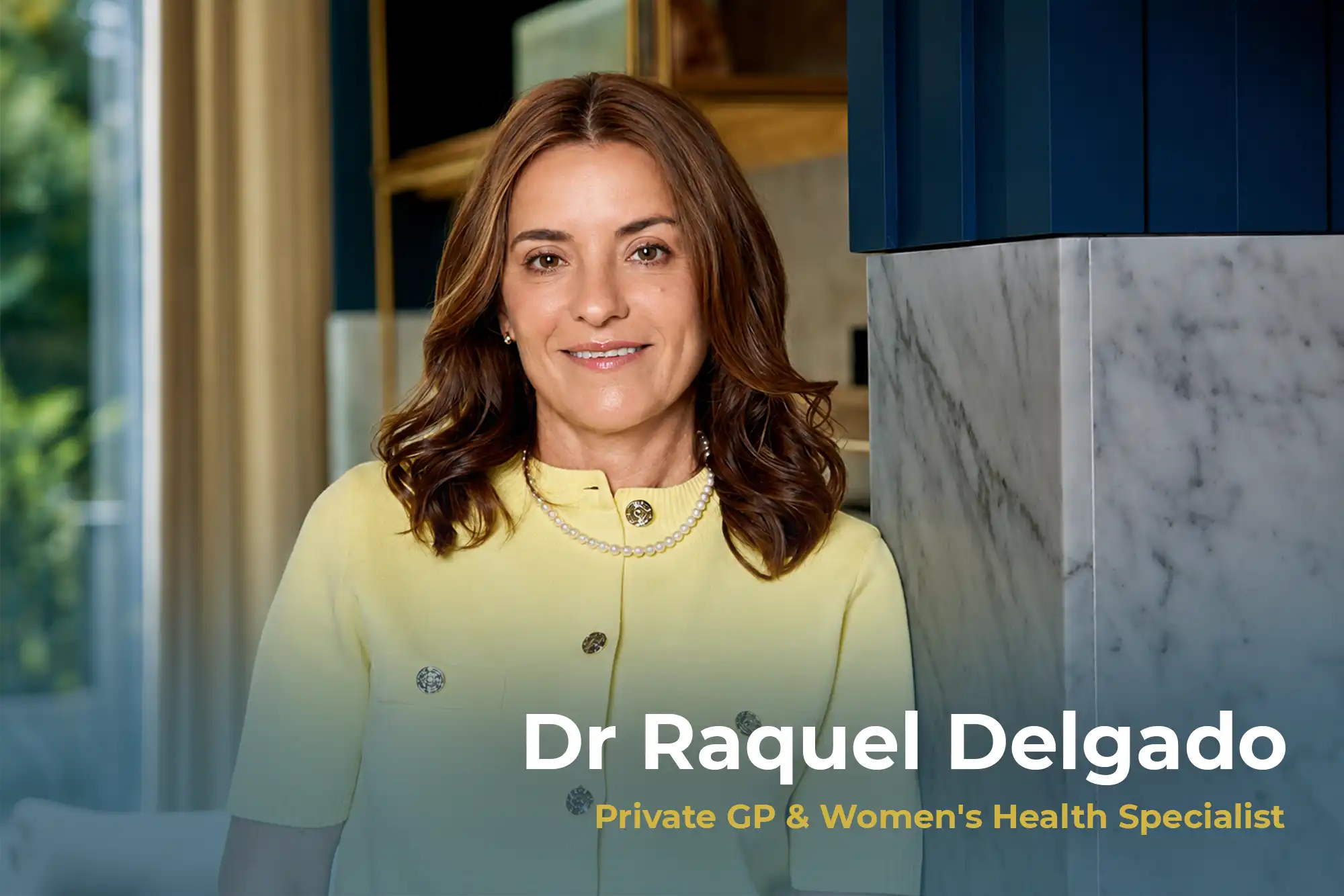
Dr Raquel Delgado is a private GP in London with more than 20 years of clinical experience in general practice, women’s health, and hormonal care. She has a particular focus on doctor-led, natural-looking aesthetic treatments for women, and consults in both English and Spanish. Every consultation is with Dr Delgado personally, giving you the same clinician’s judgement and continuity of care each time.
We see heavy periods regularly, and we start by finding the cause rather than guessing. That can mean blood tests, an examination, and referral for scans or specialist care where needed. You can read more about our practice and see the consultation fees in advance. To arrange a consultation, contact us or reach out using the details below.
If bleeding is very heavy or you feel faint, contact us straight away so we can arrange to see you quickly.
No. Many women have fibroids and never notice them, and many women with fibroids have no heavy bleeding at all. Position matters as much as size. A small fibroid inside the womb cavity can cause more bleeding than a large one on the outside.
It comes down mainly to position. Fibroids that push into the womb cavity enlarge the lining that sheds each month, while fibroids on the outer surface of the womb rarely affect bleeding. The number of fibroids and how they affect nearby blood vessels also play a part.
Changing a pad or tampon every 1 to 2 hours, bleeding for more than 7 days, or passing clots larger than about 2.5 cm all count as heavy. If bleeding interferes with sleep, work or energy, it is worth assessing even if you do not meet those numbers.
They tend to shrink after menopause, as oestrogen falls, although HRT can slow this. Before menopause they stay the same size or grow slowly. Shrinking by themselves is not something to rely on if you are bleeding heavily now.
Yes, indirectly. Heavy bleeding can lower iron, and low iron causes tiredness, breathlessness and dizziness. A full blood count shows whether this is the case, and treating low iron can make a real difference to energy.
Not always. A hormonal coil, a bleeding-reducing tablet or hormonal contraception are tried first for many women. A procedure or surgery comes into the picture when these do not work, the fibroids are large, or symptoms are severe.
It can be both. Hot flushes, night sweats and mood changes point towards perimenopause, while pelvic pressure and a swollen lower tummy point towards fibroids. Tests and an examination separate the two, which is why assessment is better than guessing.
This article is general information and not a substitute for a personal consultation. If you are worried about heavy bleeding, please speak with us.