
Last Updated: October 9th, 2026
Reading Time: 10 mins
Ovulation pain in perimenopause is often still ovulation, but it isn’t always. While you are still having periods, you can still ovulate, so a one-sided twinge in the middle of your cycle can be exactly that. As ovulation becomes irregular, though, and cysts, endometriosis and other conditions become part of the picture, mid-cycle pain needs more care than it did in your thirties. This guide explains what ovulation pain feels like, whether it gets worse, which look-alikes to know about and when to speak with us.
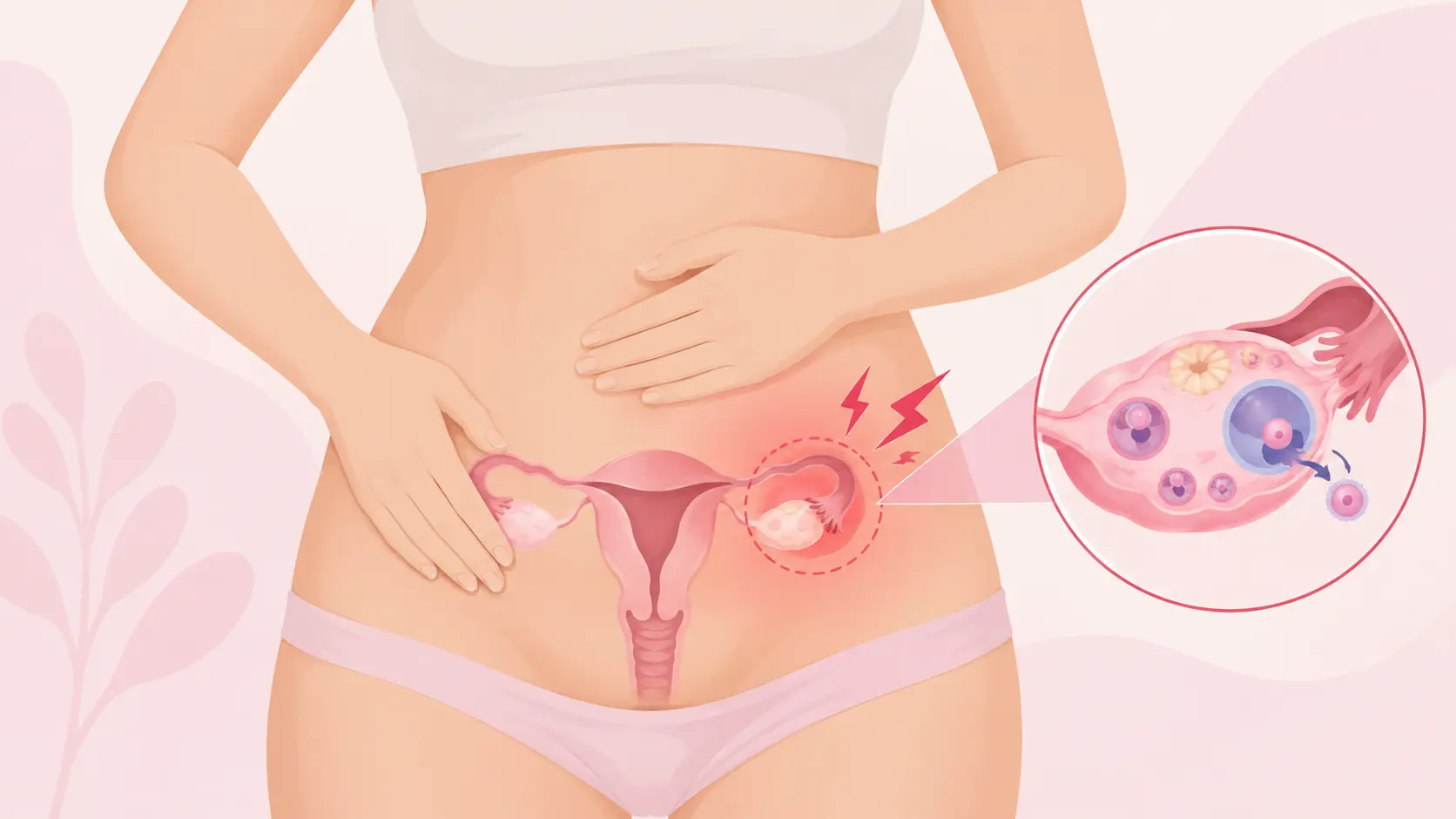
Ovulation pain perimenopause questions start with a simple fact: you can still ovulate while you are having periods, even irregular ones. Ovulation is when an ovary releases an egg, usually about two weeks before your next period. Many women feel it as a twinge or ache low on one side, and around four in ten notice it at some point. The medical name for it is mittelschmerz, from the German for “middle pain”. It is usually harmless, and its exact cause isn’t fully understood. The surface of the ovary may swell before the egg is released, and the release itself may irritate the tissue around it.
In perimenopause the difference is predictability. Your ovaries still release eggs, but not every month, and the timing shifts. Some cycles have no ovulation at all, which are called anovulatory cycles, and our guide to anovulatory cycles explains why your periods can feel off when that happens. The result can be mid-cycle pain that arrives in some months, skips others and doesn’t line up with the calendar. Irregular periods don’t mean ovulation has stopped, which is why a twinge can still be ovulation even when your last period was late, early or missed. They also mean the usual calendar maths, counting two weeks back from your next period, is less reliable than it used to be.
Can ovulation be painful in perimenopause? Yes. If you are still ovulating, you can still feel it, exactly as you might have before. Pain that has always come with your ovulation often carries on, and some women feel it for the first time in their forties. Neither pattern is unusual by itself.
Ovulation pain during perimenopause usually feels the same as it does at any age. It sits low in the tummy on one side. It may feel like a twinge, a cramp, a dull ache or a sharp stab, and it lasts from a few minutes to a couple of days. Ovulation pain one side perimenopause is the classic pattern, and the side can change from month to month, depending on which ovary releases the egg. Perimenopause mid-cycle pain that is central, on both sides or lasts well beyond a couple of days is less typical, and it deserves a closer look. What can differ is the rhythm. Because cycles are less regular, the pain may arrive earlier or later than you expect, or not at all for a few months. A simple diary of dates and symptoms across two or three cycles is the quickest way to see whether your pain follows a pattern.
Does ovulation pain get worse in perimenopause? The honest answer is that nobody has shown that it does. Many women say it feels stronger or stranger, and that experience is real, but we found no study that measured ovulation pain against hormone levels in perimenopausal women. What research does show is more hormone variability. Oestrogen can swing higher and lower than usual, and progesterone tends to be lower. These changes are thought to make cycles less predictable, and some clinicians suspect they also change how the pelvis feels, but that link isn’t proven. Other things can make perimenopause ovary pain feel sharper in a given month, including poor sleep, stress, a heavier cycle or a bloated gut, and none of them is the same as the ovary itself hurting more.
So when you ask whether ovulation pain worse perimenopause is a real pattern, the careful answer is that it can feel different, more or less often and sometimes more intense, but “worse” isn’t a reliable rule. If the pain is getting steadily stronger, that is a reason to look for other causes, not to assume it is just your hormones.
Does ovulation pain increase in perimenopause, or does it simply change? For most women it changes. It may come less often, move around more, or sit alongside other symptoms such as bloating, breast tenderness or heavier periods that make it feel bigger. A pain that is building month on month, lasting longer, or spreading beyond the middle of your cycle isn’t behaving like ordinary ovulation pain. Please don’t put that down to perimenopause. The next sections explain what else it can be.
Ovulation pain in 40s is common, and it is often the first time women connect pelvic twinges with the start of perimenopause. Perimenopause can begin years before your periods stop, and in your forties the early signs are often subtle: shorter or longer cycles, heavier bleeding, sleep changes or mood shifts. Ovulation pain can sit among them. It isn’t a reliable sign of perimenopause on its own, as plenty of women have it in their twenties and thirties. If other changes are appearing alongside it, that combination is a good reason to talk it through with us. For example, a woman of 44 who has always had a twinge at mid-cycle, and who now notices her cycles shortening, her sleep breaking up and her periods turning heavier, is describing a different picture from one whose only change is the twinge. We look at the whole pattern, not one symptom in isolation.
Severe ovulation pain perimenopause deserves a closer look, not reassurance. Ordinary ovulation pain is brief and usually manageable with simple measures. Pain that is strong enough to stop you doing normal things, lasts more than a few days or keeps coming back is more often something else. The NHS says to see a GP if pelvic pain comes and goes or doesn’t go away. This table shows how the common causes differ:
| Cause | Typical pattern | Other clues |
| Ordinary ovulation pain | One side, mid-cycle, minutes to two days | Settles on its own, no fever or heavy bleeding |
| Ovarian cyst | One side, dull ache or sudden sharp pain | Bloating, feeling full, pain with sex. Most are harmless and clear within months |
| Endometriosis or adenomyosis | Pain through the cycle, often with painful periods | Pain with sex, bowel or bladder pain, heavy periods, tiredness |
| Fibroids | Pressure or heaviness | Heavy periods, needing to pee more often |
| Pelvic infection | Lower tummy pain, sometimes with a fever | Unusual discharge, pain with sex |
Fibroids and adenomyosis often show up as heavy bleeding, which our guide to heavy periods in perimenopause explains in more detail. In Dr Raquel Delgado‘s consultations, the first step is to listen carefully to the pattern: where the pain is, when in the cycle it comes, how long it lasts and what else happens with it. An examination and, where needed, a pelvic ultrasound usually settle the question. The scan is often done inside the vagina because it gives a clearer view of the ovaries and womb, and it can show a cyst, fibroids or thickening that explains perimenopause pelvic pain. If a cyst is found, it is often watched with a repeat scan in a few weeks, because most clear on their own.
Some pain needs urgent help. Call 999 for severe or worsening pain, fainting or heavy bleeding. Use NHS 111 for pelvic pain with a high temperature, unusual discharge or bleeding, or if you could be pregnant.
Ovulation pain and bloating perimenopause often travel together. Shifting hormones can slow the gut and make you hold fluid, so a bloated tummy around ovulation is common and usually settles within days. The NHS lists bloating that comes and goes, or doesn’t go away, among the reasons to see a GP. Its ovarian cancer guidance mentions bloating, pelvic pain, feeling full quickly or needing to pee more often, happening roughly 12 or more times a month. These symptoms are very common and nearly always have another cause, but persistent or frequent ones should be checked. If your bloating isn’t tied to your cycle, or keeps going, please speak with us.
Are perimenopause symptoms worse during ovulation? Some women notice a mid-cycle cluster of headaches, breast tenderness, mood changes or poor sleep, and it makes sense that oestrogen shifts around ovulation could play a part. The evidence is thin, so we can’t promise a pattern. What helps is the same diary you may already keep for pain. If symptoms repeatedly peak at the same point of your cycle, it tells us a lot about what is driving them. Symptoms that follow the same calendar every month point to the cycle, while symptoms that wander through the month with no pattern are more often linked to sleep, stress or another condition, such as a thyroid problem, that deserves its own check.
Ovulation pain and menopause need to be kept apart. Menopause means 12 months without a period, and after that your ovaries no longer release eggs, so pain that feels like ovulation can’t be ovulation. New pelvic pain at that stage, or late in perimenopause when periods are far apart, needs assessment, not an assumption. Cysts that cause problems are more common after menopause, and the NHS notes that cancerous cysts are more likely too, although most cysts are harmless. If a cyst is found after menopause, regular scans and blood tests over a year are usually advised to keep an eye on it.
We use “menopause” here in its strict sense, but many women say “menopause” when they mean the years leading up to it. If that is what you mean, the earlier sections apply. Any vaginal bleeding after menopause should be checked promptly, and our guide to bleeding between periods explains what we look for.
Most ovulation pain settles on its own. Simple steps that help many women:
When you use the diary, note the date, the side, how long the pain lasted, how strong it was out of ten and anything else that happened that week, such as bleeding, bloating or a late period. Bring it to your consultation, because it often answers half our questions before we ask them. If the pain keeps returning, is stronger than simple measures can manage, or is changing, please don’t keep treating it at home. Ovulation can still lead to pregnancy in perimenopause, so contraception still matters if you aren’t hoping to conceive, and we can talk through the options.
Dr Raquel Delgado is a private GP in London with more than 20 years of clinical experience in general practice, women’s health, and hormonal care. She has a particular focus on doctor-led, natural-looking aesthetic treatments for women, and consults in both English and Spanish. Every consultation is with Dr Delgado personally, giving you the same clinician’s judgement and continuity of care each time.
If mid-cycle pain is new, getting stronger or changing, that calls for a proper conversation, not guesswork. We can listen to the pattern, examine you and arrange a scan if needed, so you know whether this is ordinary ovulation or something that needs treating. You can read more about our approach on our Women’s Health page, our GP services more broadly, or our homepage. Our Wellness Library offers further reading. To arrange a consultation, contact us directly or reach out using the details below:
A few signs call for prompt attention rather than waiting:
If any of these apply to you, that needs proper assessment with us rather than being left to settle on its own.
Usually from a few minutes to a couple of days. Pain that lasts longer than three days, or comes with heavy bleeding or unusual discharge, needs checking, so please speak with us.
Often, yes. If you are still ovulating, one-sided pain around mid-cycle can be ordinary ovulation. If it is severe, lasts more than a few days or is changing, it needs a closer look.
Yes, while you are still ovulating, even if your periods are irregular. If you could be pregnant and have pelvic pain, get help from NHS 111, and speak with us about contraception.
No. After 12 months without a period, ovulation has stopped, so new pain that feels like it needs assessment and shouldn’t be put down to ovulation.
Not on its own. Many women have ovulation pain in their twenties and thirties. It can sit among other changes in your forties, but those other changes are what point to perimenopause.
This article is for general information and does not replace a personal consultation. If you have concerns about pelvic pain, bloating or unusual bleeding, please get in touch with us promptly.
Webdesign by EyeMedia Creative